
By Julie Tomascik
Editor
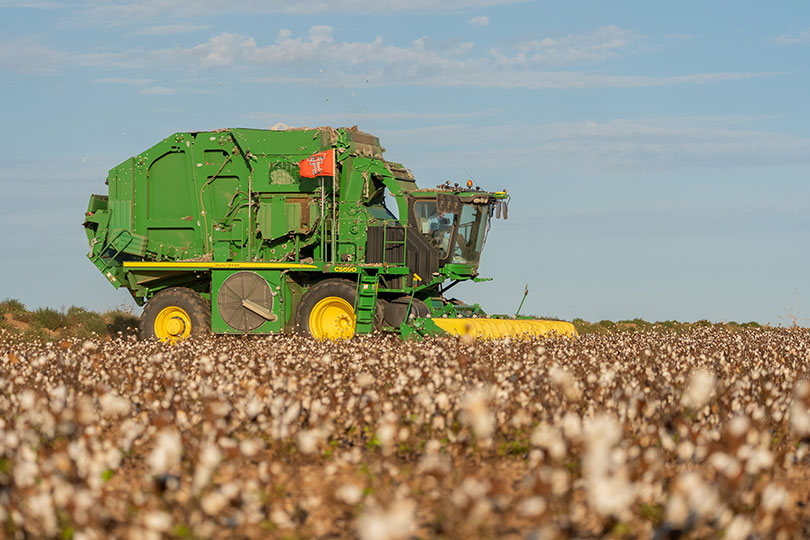
Cotton harvest is moving faster than usual for Crosby County farmer Josh Schoepf. But that’s not necessarily good news.
After months of hot, dry weather, yields on his family’s South Plains farm are significantly below last year’s production.
“Everything’s running in half, and some less than half, of what we made last year,” Schoepf said. “It’s not good, but we’re just going to get it out and start again next year.”
Schoepf farms about 5,000 acres of cotton near Lorenzo with his father and brother. They usually start harvesting in early to mid-October with hopes of finishing by Thanksgiving. This year, however, Schoepf expected harvest to only take about 10 days.
Rising costs, tighter margins
A disappointing harvest is only part of the financial challenge facing Schoepf and other Texas farmers.
Rising costs for diesel, fertilizer, seed and equipment are putting additional pressure on farm finances. Low commodity prices make it even harder for farmers to be profitable.
Schoepf began farming on his own in 2013. Since then, he’s sold his cotton for a wide range of prices. But he’s now getting about the same price for his cotton as he did more than a decade ago, even though it costs considerably more to grow it.
Those increased costs are driven partly by fuel expenses.
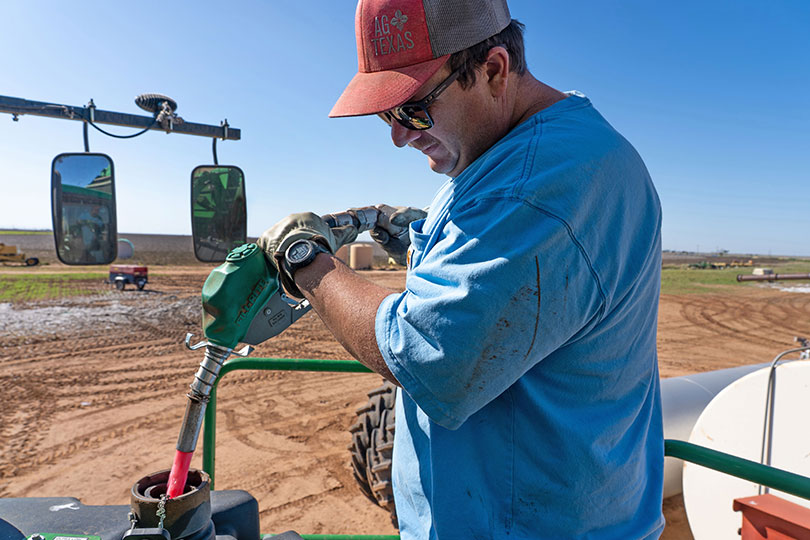
Each of their two cotton strippers can burn more than 200 gallons of diesel during a 12-hour workday. Together, the machines can use more than 400 gallons in a single day.
And that’s just the harvest equipment. Schoepf also has tractors running to plant wheat, move cotton bales and plow fields. Diesel-powered generators also operate irrigation systems in fields without electricity.
Keeping the farm fueled requires multiple, and expensive, deliveries.
“It hurt to open them,” Schoepf said of the fuel bills.
He estimated the farm’s diesel expenses could double compared to last year. Higher fuel prices also drive up the cost of parts, tires and other equipment needed.
“When fuel goes up, everything goes up,” he said.
And it gets increasingly difficult to operate in the black.
“It’s a stressful job—years like this especially,” Schoepf said. “How am I going to make my payments and pay the bank back and support my family? It’s definitely been a struggle.”
A family legacy
Despite the challenges, Schoepf can’t imagine doing anything else.
His great-grandfather began farming in Crosby County in 1923. His grandfather later farmed with his father and uncle.
Schoepf represents the fourth generation of his family working the same West Texas soil. He grew up helping on the farm and knew early on that agriculture was his future.
“I always wanted to be a farmer,” he said.
Cotton is woven into the fabric of his family’s history and the communities throughout the South Plains.
Texas leads the nation in cotton production, and the crop supports farmers, cotton gins and other agricultural businesses across the region. Cotton has long been the economic backbone of towns like Lorenzo.
“This town wouldn’t be here without cotton,” he said. “That’s what built this town, this community.”
The area’s climate and limited irrigation make cotton one of the few practical crop options for many farmers.
“Cotton’s king out here, and it’s what we do,” Schoepf said.
What does the future hold?
Schoepf knows there are challenges facing agriculture in West Texas and across the state. Declining water supplies, volatile markets and rising input costs continue to create uncertainty about the future.
Farmers in Texas and across the U.S. are spending more to grow their crops without any guarantee they’ll earn enough to cover those expenses. Years like this one make those financial pressures even more difficult to manage.
“I hope we can successfully continue to keep farming out here,” Schoepf said.
The challenges won’t disappear, but he’s committed to doing what he can to keep the family operation going. And recent fall rains have given him some encouragement for the next growing season.
Leave A Comment