
By Julie Tomascik
Editor
Texas farmers are feeling the strain as fertilizer prices, along with other production inputs, continue to rise. And a new survey shows that many farmers can’t afford to purchase enough fertilizer to get them through the year.
The survey, conducted by the American Farm Bureau Federation (AFBF) April 3-11, shows fertilizer costs are stretching farm budgets nationwide, and the impact is hitting Southern farmers especially hard.
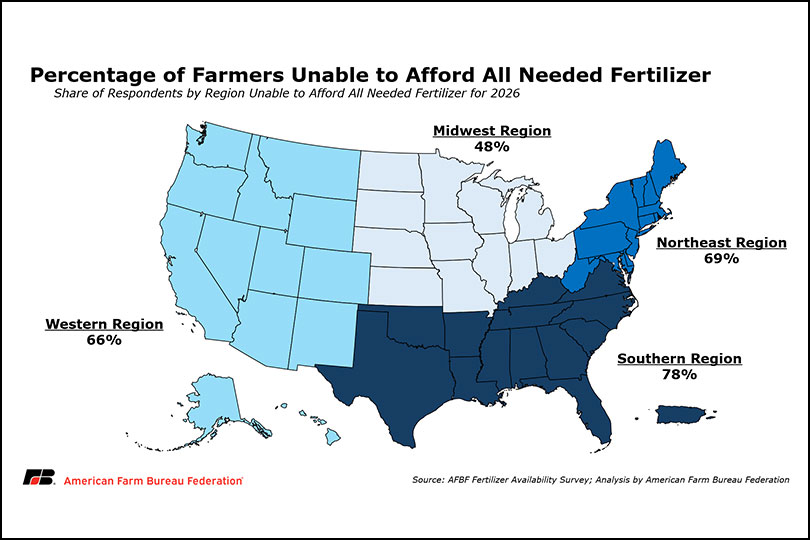
Nearly eight in 10 farmers in the South reported they can’t afford all the fertilizer they need this year. That’s higher than any other region in the U.S. By comparison, 69% of farmers in the Northeast, 68% in the West and 48% in the Midwest reported the same challenge.
The data also shows fewer Southern farmers were able to lock in prices ahead of planting. Just 19% said they prebooked fertilizer, leaving most farmers exposed to rising costs and supply disruptions.
More than 5,700 farmers from across the country, including both Farm Bureau members and non-members, participated in the survey. Results were analyzed by Farm Bureau economists in the organization’s Market Intel report.
The survey highlights mounting financial pressure on farm operations. According to the findings, 94% of farmers say their financial situation has either worsened or stayed the same compared to last year. That’s a sign that tight margins continue to weigh heavily on agriculture.
Global factors are driving much of the increase.
Conflict in the Middle East and disruptions in the Strait of Hormuz have limited the flow of fertilizer ingredients and fuel, pushing prices higher worldwide. Since tensions escalated, nitrogen fertilizer prices have climbed more than 30%, and some products have seen even sharper spikes.
As a result, some farmers say they will reduce or delay fertilizer applications. Doing so could impact yields and overall production, farm experts noted.
“The skyrocketing cost of fuel and fertilizer is creating more economic hardships for farmers who have already endured years of losses,” AFBF President Zippy Duvall said. “Without the necessary fertilizers, we’ll face lower yields and some farmers will reduce acres altogether, which will impact food and feed supplies. It’s too early to know how this will affect food availability and prices in the long run, but it’s a warning light that we’ve shared with leaders in Washington. We look forward to working with them to find solutions so farmers can continue to feed families across America.”
Texas farmers are already seeing those pressures play out in real time. With much of the state’s planting season underway or complete, higher input costs are cutting into margins and limiting flexibility for the remainder of the growing season.
Texas Farm Bureau recently met with U.S. Secretary of Agriculture Brooke Rollins to discuss rising fertilizer costs and the challenges they pose.
Following that meeting and continued engagement from farmers and ranchers, President Donald Trump addressed fertilizer prices on social media and said the U.S. will not accept price gouging from fertilizer companies.
“Thank you for the many Texas farmers and ranchers who responded to the survey. Their information is critical to helping us tell leaders in Washington, D.C. and others about what’s actually happening on the ground,” TFB President Russell Boening said.
Get more survey results and read AFBF’s Market Intel report here.
Leave A Comment