
By Emmy Powell
Communications Specialist
Students in grades K-5 learned about oyster production through Texas Farm Bureau’s (TFB) Farm From School program.
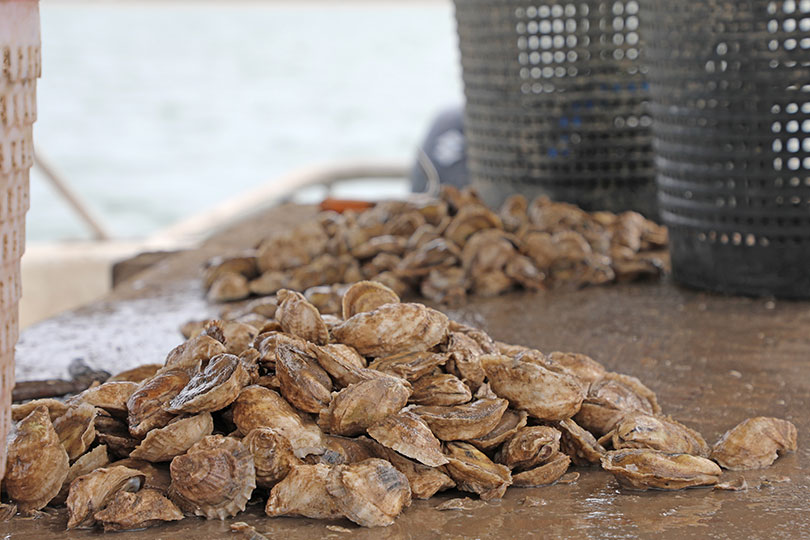
During the 30-minute virtual session, Jacob Aparicio, co-owner of Oyster Bros, gave students a tour of his farm and taught them about mariculture, which is farming of oysters in saltwater.
Aparicio and his brother have been farming oysters since 2022. Their farm covers 30 acres and can hold about 6 million oysters.
He told the students the oysters begin in a hatchery.
“They go from the size of quinoa and rice to almost two-and-a-half inches in five months,” Aparicio said.
From there, they move to a nursery and then are placed in mesh bags inside floating baskets that are anchored to lines along the bay floor and suspended near the surface.
As the oysters grow, they are sorted and graded by size, dividing the crowded bags to give the oysters more room to grow.
“Oysters are no different than when you go to a feedlot, a 200-pound calf eating with a 200-pound calf, and a 300-pound calf eating with a 300-pound calf. Oysters are the same way,” he said. “You want them sorted by size. That way, everything’s equal, grows equally.”
Students also saw the technology and equipment used on the oyster farm.
A boat can hold between 15,000 and 25,000 oysters before they are brought to the processing facility.
At the facility, the oysters move through conveyors before reaching a vision grader, which takes a picture of each oyster and sorts it by size. The machine can process up to 16,000 oysters an hour.
“Technology is good because if we didn’t have this, we’d be doing it by hand,” Aparicio said.
After processing, oysters return to the water for about two weeks before they are sold. The operation also checks meat yield and the meat-to-shell ratio.
Oysters typically reach market size in six to eight months.
Aparicio also explained how weather conditions can impact oysters. The oysters typically thrive in salinity levels between 10 and 20 parts per thousand, but drought conditions have pushed those levels higher.
“That’s bad because the oysters aren’t going to grow as quick. If it wasn’t for the early rainfall that we had early on during the year, our oysters would be a lot smaller,” he said.
Just like other crops, too much or too little rain can affect oyster production.
Students also asked if their oysters have pearls.
“Typically, you don’t find pearls in farmed oysters, but the third oyster we ever shucked had a small baby pearl in it. That’s how we came up with the name Matagorda Pearl,” he said.
Their oysters can be found in restaurants across Texas and throughout the U.S., including New York City.
More information about Farm From School
Through Farm From School, K-5 students virtually meet with a farmer, rancher or agricultural professional once a month. This semester, students also will learn about pumpkins, grain sorghum and beef cattle.
Students in grades 6-12 learned about turfgrass production in September and will learn about drones in November.
Sign up for the Spring 2027 program will open this month.
Click here for more information about the Farm From School program.
Visit texasfarmbureau.org/aitc for more information and the latest announcements on TFB’s Agriculture in the Classroom® activities.
Leave A Comment