
By Jessica Domel
Multimedia Reporter
The world’s largest ammonia plant, which is expected to help strengthen the U.S.’ fertilizer supply chain, is one-step closer to opening its doors.
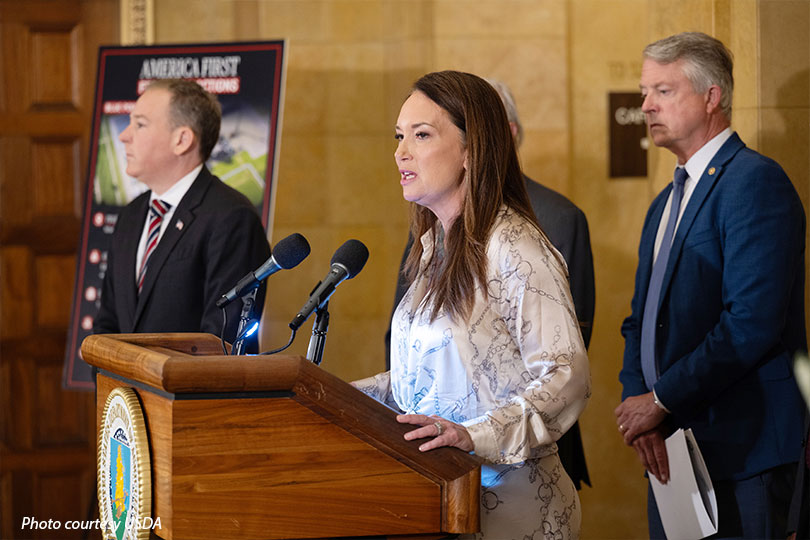
U.S. Secretary of Agriculture Brooke Rollins gave an update on the administration’s efforts to bolster domestic fertilizer production and lower fertilizer prices May 19, saying the Blue Point Project in Modeste, Louisiana is moving at “Trump Speed.”
“Within 45 days, we should see permitting wrapped up on this project to build a $3.7 billion ammonia plant, which, when opened, will become the world’s largest ammonia plant,” Rollins said. “We’re so excited about not only the fertilizer implications of that, but the hundreds and hundreds of jobs that will come along with it.”
According to USDA, the plant is expected to produce 1.4 million metric tons of ammonia annually and 313 jobs.
“When Secretary Rollins brought this project to our attention, as (Energy) Secretary (Chris) Wright mentioned, this project was mired in New Deal red tape,” Adam Telle, assistant secretary of the Army Office of Civil Works, said. “We got to work, and we expect to have a decision on this project within 45 days, but we didn’t stop there. President Trump, at the beginning of his administration and again earlier this year, issued executive orders around energy and fertilizer that told the inner agency to get to work on it. We’ve used the energy executive order to permit more than 1,000 energy related facilities during President Trump’s term. We are taking that same effort and applying it now to fertilizer.”
A few days before the announcement, the Army issued a memorandum to remind the workforce that when it comes to fertilizer, they should not be deferred by red tape, Telle said.
“All the ambiguity is out of the system,” Telle said. “We expect to get this project online, as well as many others, very soon. I would just also add as it relates to the U.S. Army Civil Works Program, this facility happens to be located on the Mississippi River, and there’s a reason for that. That’s because the inland waterway system that we build and maintain enables the inputs for farmers all across America in the heartland to go into the system and then to have their products flow throughout the country into the world.”
According to USDA, the project is made possible by $3.7 billion in private investments by CF Industries, JERA and Mitsui and Co.
Commercial production at the plant is expected to begin in 2029.
Ammonia, which the plant will produce, is a building block used in nitrogen fertilizers.
Rollins also announced USDA is rescoping projects that have otherwise stalled in the Fertilizer Product Expansion Program (FPEP).
“FPEP was originally conceived with a very good thought in mind and that is we have to reshore our fertilizer production here in America, but what we found when we inherited and began to dig into the program was that, of course, it focused on climate instead of fertilizer impact,” Rollins said. “Of the 121 projects that were identified in the last administration, only eight were moved to completion.”
She said 90 of the projects lacked agreements and seven were marked unsatisfactory.
“In most instances, there was zero contact information recorded for the awardees. We have now changed that. We are in touch with every single one of them. We have run it down,” Rollins said.
The formerly-stalled fertilizer projects are now back online, per Rollins.
“You can hear a little bit more about that in the coming weeks. We’ll be assisting the higher impact awardees with project completion, putting them on Trump speed. For example, an $80 million investment in Washington state under this program that again was stalled, was projected to produce 700,000 tons annually of hydrogen ammonia fertilizer that will support over 200 jobs,” Rollins said. “We expect construction to begin this year.”
A $3.89 million project in Iowa will host a ribbon cutting this summer, specifically to expand domestic organic fertilizer production capacity through large scale composting and nutrient processing.
“Taken together, we expect these projects at the highest level to unlock over two million tons of new annual fertilizer capacity, serving 61,000 producers and adding an additional 30 million acres that will be covered by American-produced fertilizer. That will create over 500 jobs and reduce reliance on foreign investments,” Rollins said. “I think that this is a really important long-term step, but we’re taking these steps immediately to get to the goal of reshoring all fertilizer to our country.”
The secretary said additional announcements on fertilizer production and efforts to lower costs are expected soon.
Leave A Comment