
By Julie Tomascik
Editor
Federal agencies are expanding coordination to protect U.S. agriculture from New World screwworm (NWS) and other animal and plant health threats.
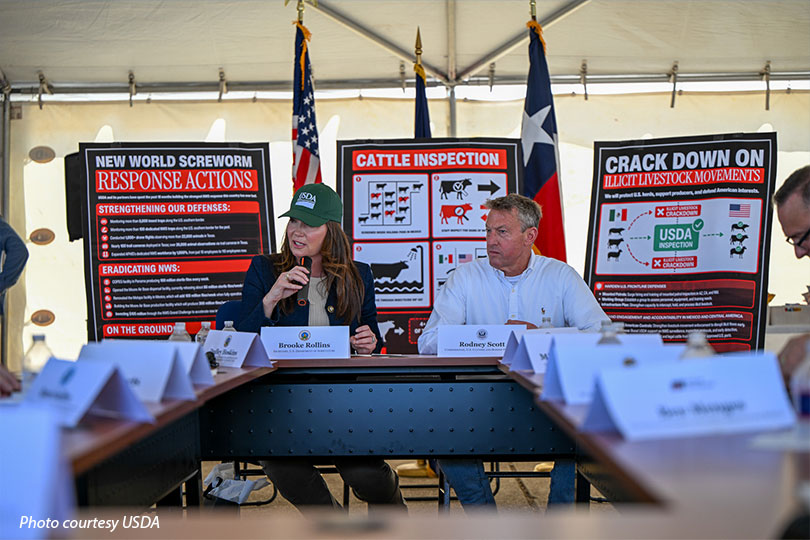
U.S. Secretary of Agriculture Brooke Rollins announced a new memorandum of understanding between the U.S. Department of Agriculture (USDA) and Department of Homeland Security (DHS) during an Aug. 10 visit to Moore Air Base in the Rio Grande Valley.
The agreement combines USDA’s animal health expertise with DHS border security and inspection authorities to improve detection and response to agricultural threats.
“The United States has the strongest food and agriculture system in the world,” Rollins said. “This new agreement builds upon the National Farm Security Action Plan in partnership with DHS. The MOU further aligns our animal health mission with DHS’s border, security and inspection authorities, so we are better positioned to detect, assess and respond to agricultural threats like New World screwworm. Together, we can move faster and more effectively to better support and protect America’s animals, people and agricultural resources.”
Under the agreement, the agencies will use unmanned aircraft systems and artificial intelligence to improve screening and detection at ports of entry, between ports and within border enforcement zones.
USDA and DHS also will share actionable biosurveillance and information in real time and establish protocols for coordinated response efforts, joint training and capacity building. Research partnerships will focus on developing new screening, detection and mitigation technologies.
The agreement also targets illegal cattle movement. USDA estimates about 800,000 head of cattle, representing roughly $320 million in illicit trade, are smuggled annually from Central America into Mexico. Those animals can bypass sanitary inspections and traceability systems, which increases biosecurity risks.
During the visit, Rollins toured construction of USDA’s domestic New World screwworm sterile fly production facility at Moore Air Base. USDA said construction is ahead of schedule and anticipates the facility opening April 1, 2027.
The facility is part of federal efforts to increase domestic sterile fly production and combat the spread of NWS.
For more information about USDA’s efforts to prevent and prepare for NWS, visit screwworm.gov.
Leave A Comment