
By Julie Tomascik
Editor
A decades-old tool to fight a devastating pest is getting a new home in the Rio Grande Valley.
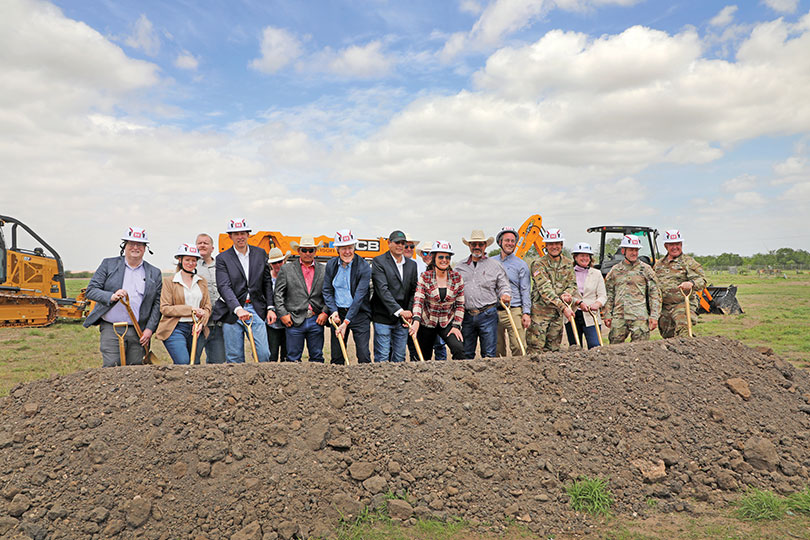
Federal and state officials held a groundbreaking ceremony April 17 at Moore Air Base in Edinburg for a domestic sterile fly production facility that will help strengthen the nation’s defenses against the New World screwworm (NWS).
The facility, a partnership between the U.S. Department of Agriculture (USDA) and the U.S. Army Corps of Engineers, will produce sterile male flies used to suppress and ultimately eliminate screwworm populations. The technique, known as the sterile insect technique, has been successfully used in the past to eradicate the pest from the U.S.
Once operational, it is expected to produce up to 100 million sterile flies per week initially, with plans to scale up to 300 million per week.
“Breaking ground on this facility marks a major investment in safeguarding America’s livestock and the producers who feed this nation. This puts NWS sterile fly production in American hands, so we do not have to rely on other countries for the best offensive measure to push screwworm away from our borders,” U.S. Secretary of Agriculture Brooke Rollins said.
More than 20,000 cases of NWS have been found in Mexico during the current outbreak that dates back to November 2024. There are currently 1,295 cases considered active.
“Screwworm threatens the health of our herds, the stability of rural economies and the resilience of our supply chain,” Rollins said. “President Trump and his entire cabinet is committed to leveraging every resource necessary to contain this pest, protect American agriculture, and ensure the long-term security of our food supply chain.”
The New World screwworm is a parasitic fly whose larvae feed on living tissue, posing a serious threat to livestock, wildlife and, in rare cases, humans. Although it has not been detected in the United States during this outbreak, recent detections in Mexico have heightened concern among agricultural leaders.
The new facility will complement existing sterile fly production efforts in Central America and provide additional capacity closer to the U.S. border.
Texas Farm Bureau leaders said the investment is critical for ranchers and rural communities who could face significant economic losses if the pest reaches the state.
“This is a significant step, but there is still work to do. We urge USDA and the Army Corps of Engineers, working with the Department of War, to remove government red tape where possible to swiftly complete construction and move to full production and distribution of sterile flies,” TFB President Russell Boening said. “Equally important, this must be a permanent facility with sustained research capacity to confront NWS and future pest threats.”
The project is part of a broader effort that includes increased surveillance, coordination with international partners and continued research to improve response strategies.
The facility is expected to be operational by November 2027.
Leave A Comment