
By Shelby Shank
Field Editor
Widespread disease pressure is taking a toll on Texas wheat fields this year as farmers across the state report significant issues.
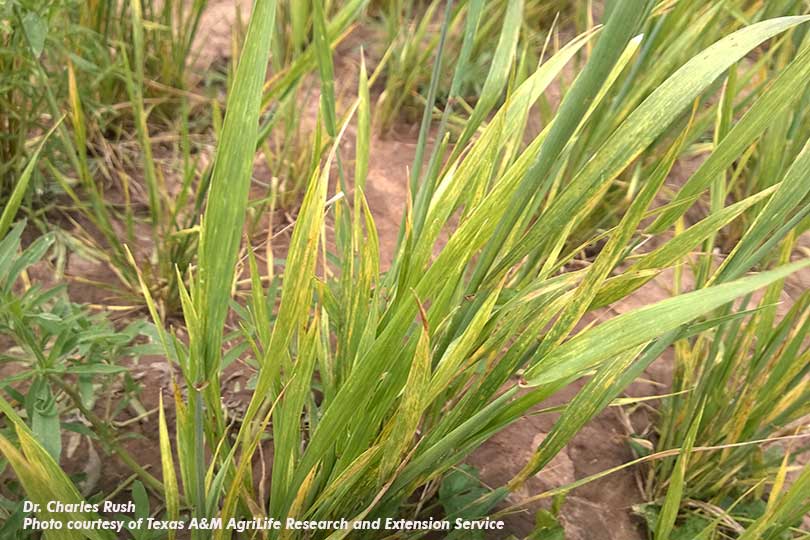
“We’ve heard reports from farmers across the Panhandle and South Plains, as well as Central Texas, of disease outbreaks in wheat fields,” said Steele Fischbacher, executive director of the Texas Wheat Producers Board and Association. “Most of the early diagnostic information that’s coming back is that these fields have, in most cases, more than one disease.”
A dozen counties—Hutchinson, Oldham, Carson, Deaf Smith, Randall, Castro, Swisher, Lamb, Hale, Lubbock, Tom Green and Hill—have sent samples to the Texas High Plains Plant Disease Diagnostic Laboratory for analysis.
Several of the reported diseases, such as wheat streak mosaic virus, Triticum mosaic virus and High Plains disease, are transmitted by the wheat curl mite..
Barley yellow dwarf virus has also been prevalent this year, and researchers are monitoring emerging bacterial diseases to better understand how they spread and how to manage them.
“These diseases can range in severity of impact on yield,” Fischbacher said. “In many cases, when you get a severe outbreak, you would make a different management decision on end use. If you were targeting grain production and you have a severe infection, you’re likely going to lose a big part of your yield potential and maybe make an early decision to go to hay or silage or some other harvest means.”
Fischbacher noted some farmers are turning cattle out to graze remaining forage, depending on field conditions.
Unfortunately, management options are limited once there is a disease outbreak, but Fischbacher did recommend some prevention strategies.
“For wheat streak mosaic and the wheat curl mite related disease, the suggestion is to plant early in the season,” she said. “Make sure you don’t have a green bridge that allows mites to move into your field and look for wheat varieties that are resistant to the wheat curl mite.”
When scouting fields, farmers should watch for visible symptoms on plant leaves.
“Almost always there will be some type of presentation on the leaf tissue,” Fischbacher said. “What you might see from the road is stunted areas or yellowing in the field.”
Bacterial infections may appear more uniformly across a field, she added, and symptoms can overlap, making diagnosis difficult without lab testing.
“It is sometimes difficult to tell exactly which disease you’re dealing with because they can present in similar ways,” Fischbacher told the Texas Farm Bureau Radio Network. “That’s why taking a sample and submitting it to the lab is a good next step.”
Drought and extreme weather have also weakened this year’s wheat crop.
Most of Texas’ winter wheat has suffered from dry conditions and a winter freeze, leaving plants more vulnerable to disease and insect pressure. Currently, 54% of the state’s wheat areas are rated poor to very poor.
Farmers can find submission information for plant samples by searching for the Texas High Plains Plant Disease Lab or by calling 806-677-5625.
Leave A Comment