
By Shelby Shank
Field Editor
Every crop comes with its share of challenges, but an overabundant deer population is destroying some crops long before harvest.
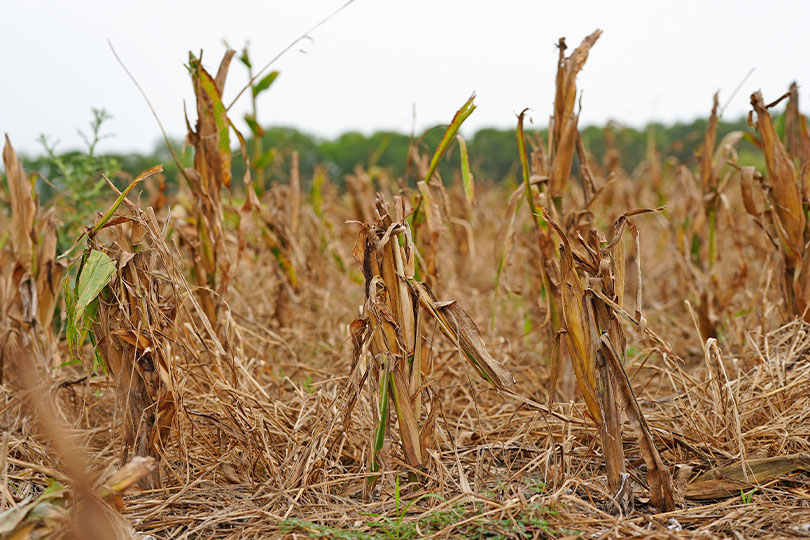
“People would ask us how the corn’s doing, and my answer would always be, ‘It looks good, except where the deer ate it off,’” Benjamin Hahn, a row crop farmer from DeWitt County, said.
The year started with little reason for optimism.
“We started out bone dry this year,” Hahn said. “There was no chance of growing anything.”
Late spring rains, however, changed the outlook enough for Hahn to plant corn.
“It rained, and our crops started progressing and were looking pretty good,” he said. “I mean way better than we could have expected.”
But the promising crop hit another snag.
“When you plant, you want to grow a good crop,” he said. “But then, as soon as the corn comes up, you see it’s ruined because the deer just keep eating and eating it.”
The problem isn’t a few deer wandering through the fields. Hahn said hundreds return night after night.
“We had 800 acres of corn with 400 deer on it every night, and we couldn’t do anything about it,” he said.
Hahn estimated there was roughly one deer for every two acres of corn, which is far above what is considered a balanced population. According to Texas Parks and Wildlife Department, deer density in Texas averages about 40 deer per 1,000 acres, or roughly one deer per 25 acres.
“We’re way beyond the average, and it’s out of balance,” Hahn said. “When you have that many, it’s a problem. We need to figure out a way to get the population more in check so that it’s balanced.”
As the crop emerges, the deer repeatedly graze the leaves, which stunts crop growth, and in some cases, kills the plant altogether.
Even surviving plants often fail to produce a marketable crop.
“It’ll maybe be knee-high or shorter than it normally would be, but it’s still trying to put an ear on,” Hahn said. “It’ll have an ear with no tassel, so it’s not going to pollinate or make a very good ear.”
The damage isn’t limited to corn.
“The deer have really hurt our corn, but they’ve also gotten our cotton when it’s young,” Hahn said. “You’ll get a good stand to come up, but then you come back a few days later and see that the stand is damaged or missing.”
The damage has taken a significant toll on Hahn’s farm.
“I’d say close to 50% of our acres have been lost from deer,” he said.
By the time that damage occurs, farmers have already invested thousands of dollars in seed, fertilizer, fuel, equipment and labor with little chance of recovering those costs.
Hahn estimates his losses average about $430 per acre.
“You multiply that by 1,000 acres of corn and that’s $430,000,” he said. “I’m just one farmer, and there are farmers up and down here in the same situation.”
Hahn said the deer have been damaging crops in his area for at least 15 to 20 years, and the problem has only intensified.
“We quit planting corn in some places and started looking for something else to plant,” he said. “But it’s not easy when this is all you’ve ever known.”
He believes the growing deer population is a result of a lack of natural predators.
“Without predators helping control them, it’s hard,” Hahn said. “Farmers have a lot of other things to manage, and hunting may be something you like to do, but you don’t always have time for it.”
But the fields that escaped heavy deer pressure showed what this year’s crop could have been.
“There’s corn where the deer didn’t mess it up, and it’s proving to be a good year,” Hahn said. “We never thought we were going to make 100 bushels of corn or think there was a chance to make any corn this year.”
Leave A Comment