
By Julie Tomascik
Editor
Gov. Greg Abbott expanded Texas’ New World screwworm disaster declaration June 5 in response to the pest’s arrival in Texas and authorized the use of “all available resources of state government” to respond to the disaster.
The declaration came two days after New World screwworm was confirmed in a three-week-old calf in Zavala County, marking the pest’s first detection in Texas in decades. The U.S. Department of Agriculture later confirmed additional cases.
The order also makes additional state personnel and resources available to assist with eradication efforts, including increasing sterile fly availability and expediting construction of the sterile fly production facility in Edinburg. It prioritizes sending resources to Uvalde and Zavala counties.
“I am making all state personnel available to accelerate the movement of sterile flies into Texas and the construction of the new sterile screwworm production facility in Edinburg,” Abbott said. “We have eradicated this pest before, and we will do it again.”
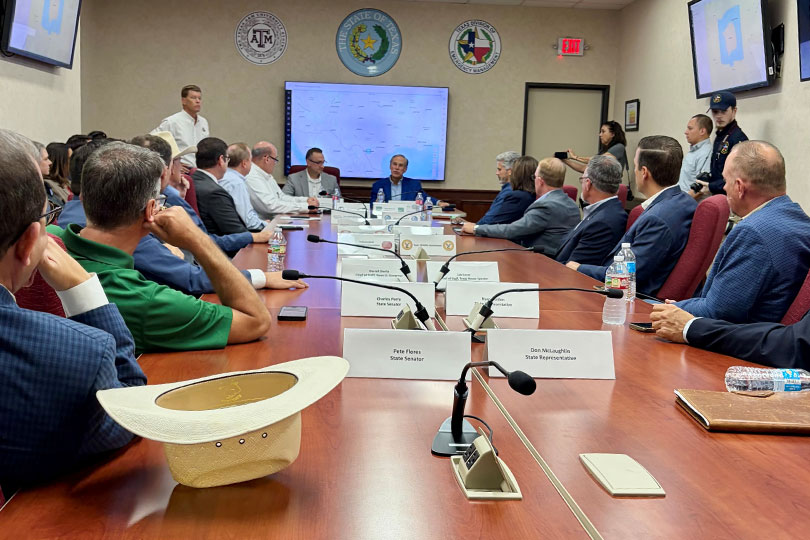
Abbott met with state and federal officials, livestock industry leaders and wildlife stakeholders in Austin before announcing the expanded disaster declaration. Representatives from the Texas Animal Health Commission, Texas Parks and Wildlife Department, U.S. Department of Agriculture, Texas Farm Bureau and other stakeholder organizations participated in the discussion.
Stephen Bauer, Texas Farm Bureau District 10 state director, attended the meeting and said the governor emphasized the need for a rapid response.
“The governor’s message was we have screwworm in the state of Texas now. We need to address it as quickly as possible,” Bauer said. “He was very much about expediting the response and doing what we can quickly.”
State and federal response efforts currently include increased trapping and surveillance, animal inspections, targeted movement restrictions and releases of sterile screwworm flies.
The sterile insect technique, which was previously used to eradicate New World screwworm from the United States, relies on releasing sterile male flies that mate with wild females. Because female flies mate only once, no viable offspring are produced, and the population declines over time.
“Here is the reality of this cycle. This is likely to spread over the course of the summer. During winter months, it may kill off the flies or reduce their number, but we can’t make it through a second summer,” Abbott said. “So, I am pushing for the facility in the state of Texas, under construction right now, to be completed by May of next year, as opposed to November of next year.”
USDA representatives said projections showed New World screwworm could have reached Texas last year. They credited extensive federal and state preparation and response efforts with delaying the pest’s arrival until this month.
“I think overall the message that came out today is there’s been a lot of progress,” Bauer said. “We’re far ahead of where we could have been. The agencies have been working on this for a year and a half.”
Since January, USDA officials said more than 130 million sterile flies have been released in Texas.
Officials encourage livestock owners, pet owners and wildlife managers to closely monitor animals for wounds containing larvae and immediately report suspected cases.
Additional information and situational updates are available at screwworm.gov.
Movement restrictions and potential quarantines will be posted on TAHC’s website.
Leave A Comment