
By Emmy Powell
Communications Specialist
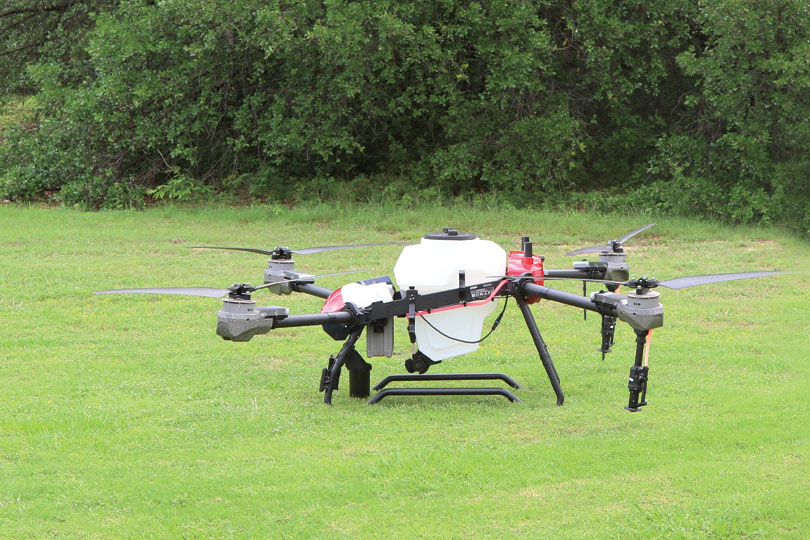
Agricultural drones are becoming an increasingly popular tool for farmers and ranchers looking to improve efficiency and productivity.
About 16.4 million acres were treated by agricultural drones in 2025, up from 10.3 million acres in 2024 and 3.7 million acres in 2023, according to the American Spray Drone Coalition.
Drones aren’t replacing traditional farm equipment, though.
“Instead, they fill in where traditional equipment and tools leave gaps,” Bernt Nelson, an economist with the American Farm Bureau Federation, said. “Farmers are increasingly finding situations where drones offer both economic and operational advantages over conventional application methods such as ground equipment or airplane applications.”
Drones can be useful when wet soils, rough terrain or sensitive crops limit access for ground equipment. They also provide another option when conventional aerial applicators are difficult to schedule or when applications need to be made quickly.
Using drones can also help reduce soil compaction and potential crop damage.
Agricultural drone use varies by country, depending on farm size, terrain and production practices.
China reported more than 120,000 agricultural drones in operation in 2021, treating about 175.5 million acres. In the U.S., drones have developed a more specialized role within crop production systems.
“Comparing adoption rates between China and the United States does not necessarily indicate one system is more advanced than the other,” Nelson said. “The technologies are being used to solve different agricultural production challenges.”
The growing use of drones also creates business opportunities in rural communities.
Custom drone operators can provide services such as crop protection applications, cover crop seeding and field scouting. These services can benefit farmers who need flexible application options but may not want to purchase and maintain their own equipment.
Operating a successful drone application business, however, requires more than purchasing equipment.
Professional applicators need knowledge of agronomy, pests and diseases, and application technology. They also must meet applicable licensing and certification requirements and have business management skills to provide services safely and effectively.
As drone-treated acreage continues to grow, the technology is becoming another option for farmers managing challenging field conditions and narrow application windows.
“The rapid increase in treated acreage suggests that drones are moving beyond niche technology with limited applications and becoming another management option within modern crop production systems,” Nelson said.
Additional information about drone use in agriculture is available in this Farm Bureau Intel report.
Leave A Comment