
By Julie Tomascik
Editor
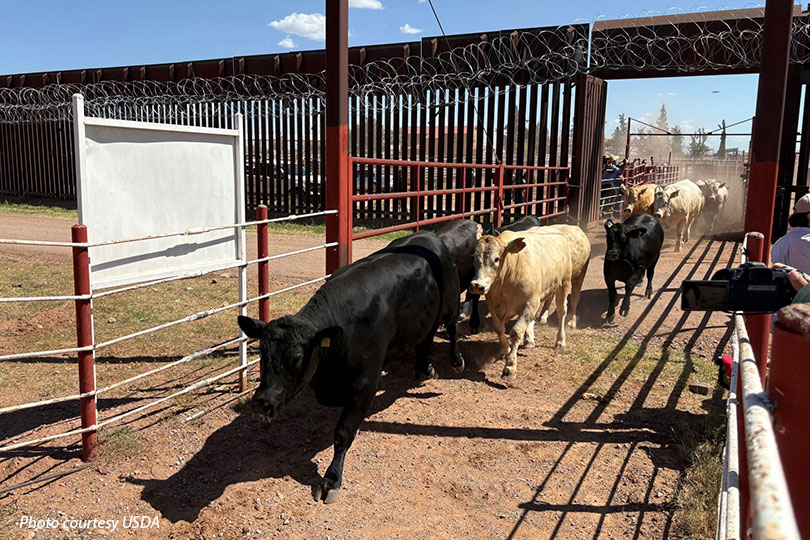
Mexican cattle imports to the U.S. resumed Monday, Aug. 24, at the port of entry in Douglas, Arizona, for the first time in over a year.
The Douglas port is the first to reopen under the U.S. Department of Agriculture’s (USDA) phased approach to restoring livestock trade with Mexico since the border was closed in May 2025.
On the first day, 692 head successfully completed the import process. Eleven cattle were rejected for reasons unrelated to New World screwworm (NWS).
Cattle arriving from export gathering centers in Sonora have their initial treatments and certifications verified before undergoing an individual visual inspection by USDA animal health personnel. Animals with open wounds, lameness, eye damage or other concerns are removed and are not eligible for import.
Eligible cattle then go through a screwworm detector dog inspection. Their identity and traceability are confirmed, and an FDA-approved preventative is applied before the cattle are dipped.
“It is a very stringent protocol. It is essential that we follow it, comply with it, and meet those standards,” Dudley Hoskins, USDA undersecretary for Marketing and Regulatory Programs, said. “We have every confidence that protocol will ensure there are no cattle transmitting screwworm through legal safe channels at ports of entry.”
Questions remain about the pace of cattle imports as USDA and Mexican officials work through a backlog created during the closure.
USDA has not set a target for the number of cattle that will cross each day.
“Our primary focus is to make sure the inspection and treatment protocols are met with 100% certainty and efficacy,” said Hoskins, who was at the Arizona port as cattle entered the U.S.
Historically, the U.S. has imported more than 1 million Mexican cattle annually. Imports averaged about 1.17 million head from 2004 through 2023, although totals varied from year to year.
USDA continues to monitor NWS activity on both sides of the border.
An NWS case was confirmed in Sonora, Mexico, just days before trade was scheduled to resume. USDA said the detection would not delay the reopening because of surveillance, sterile fly releases and other safeguards already in place.
“For 18 months, we have built a coordinated, highly sophisticated system,” USDA posted on X.
That system includes more than 100 NWS-specific traps along the southern border and thousands of other insect traps. USDA is also dispersing sterile flies in Mexico and Texas to help slow the screwworm’s spread.
The agency has invested $21 million to renovate a sterile fly production facility in Metapa, Mexico. The facility is operational and is ramping up to produce up to 100 million sterile flies each week. It is expected to eventually produce the NovoFly, a male-only strain designed to increase the efficiency of the sterile insect technique.
Ongoing livestock trade remains contingent on Mexico’s progress in meeting requirements under a joint action plan. USDA could pause trade if conditions increase the risk to U.S. livestock.
After evaluating the Douglas reopening, USDA will consider reopening ports in Santa Teresa and Columbus, New Mexico, to cattle, bison and horses. No dates have been set for those ports.
Leave A Comment