
By Shelby Shank
Field Editor
The sterile fly program was underway before New World screwworm was confirmed in Texas, positioning federal and state officials to respond quickly when the first case was identified.
The U.S. Department of Agriculture began ground dispersal operations from Moore Air Base in Edinburg earlier this year as New World screwworm cases moved north through Mexico. Now, with multiple cases confirmed in Texas, those operations have become a key component of state and federal eradication efforts.
What is New World screwworm?
New World screwworm is a parasitic fly whose larvae feed on living tissue. The pest can infest livestock, wildlife, pets and, in rare cases, humans. Left untreated, infestations can cause severe injury and death.
The U.S. Department of Agriculture (USDA), Texas Animal Health Commission (TAHC), Texas Parks and Wildlife Department (TPWD) and other partners are working to stop the spread of the pest.
Central to that effort is the sterile insect technique, the same eradication strategy that successfully eliminated New World screwworm from the U.S. in the 1960s.
Sterile insect technique
One of the primary tools being used is the sterile insect technique, a method that involves releasing sterile male flies to disrupt reproduction and help eliminate screwworm populations over time.
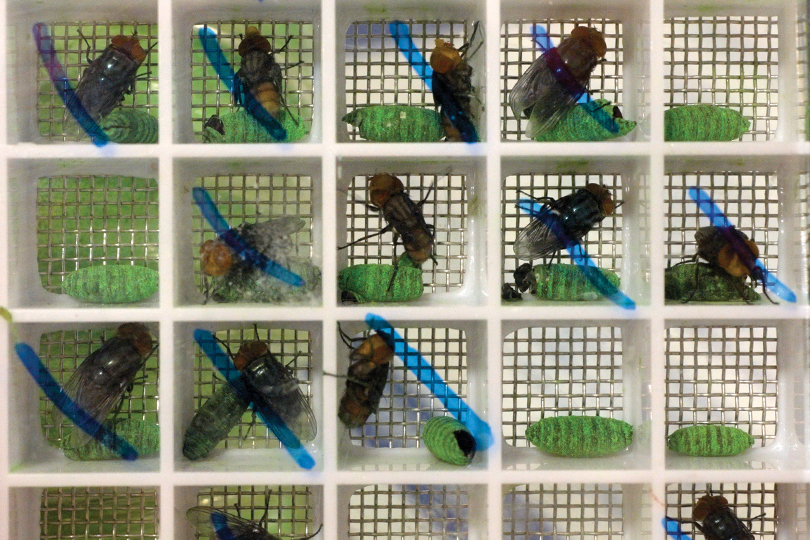
Because female screwworm flies mate once during their lifetime, mating with a sterile male results in eggs that do not hatch.
Over time, repeated releases suppress and eventually eliminate the screwworm population.
The technique successfully eradicated New World screwworm from the United States in the 1960s and remains one of the most effective tools available to combat the pest today.
As part of current response efforts, USDA partnered with the U.S. Army Corps of Engineers to establish a domestic sterile fly production facility and dispersal center at Moore Air Base in Edinburg.
“Moore Air Base was chosen because of its close proximity to the border, which allows us to disperse the sterile flies into multiple areas where they’re needed,” said Gabe Lopez, logistics facility operations specialist at Moore Air Base. “We’re about 20 miles north of the U.S.-Mexico border, so logistically Moore Air Base allows us to do both ground dispersal and aerial dispersal in targeted areas.”
USDA partners with an international sterile fly production facility in Panama that produces about 100 million sterile flies each week that are then shipped to Texas.
The flies are bred in controlled conditions and sterilized during the pupal stage using irradiation, a process that ensures they remain active but unable to reproduce.
From pupae to release
Each week, sterile pupae are transported from Panama to Moore Air Base for processing and dispersal.
“It takes a full day before the pupae reach Moore Air Base,” said Edgar Cruz, veterinary medical science worker at Moore Air Base. “You have to carefully control the temperature throughout the trip, keeping them around 58 degrees to delay emergence until they’re ready for processing.”
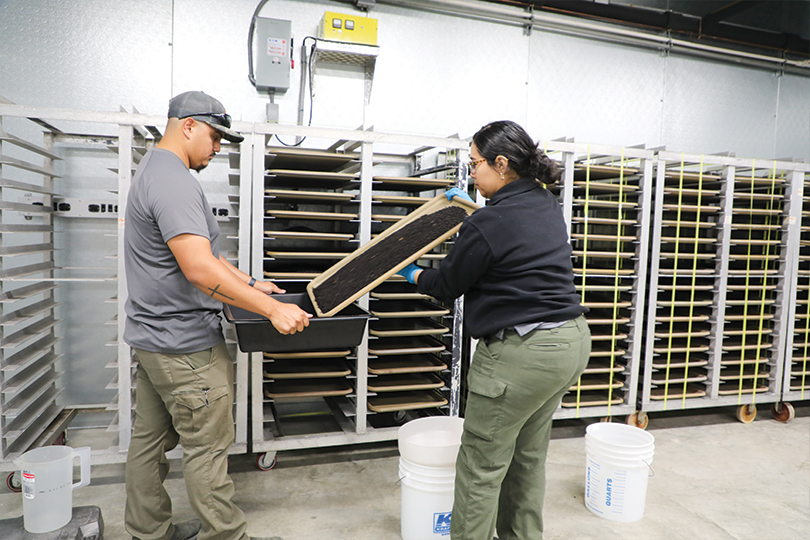
Once the pupae arrive in Texas, they are immediately placed into coolers to prevent early emergence, the process in which the adult flies begin to develop and break out of the pupal stage.
The pupae remain chilled for at least 12 hours overnight before they are sorted and coated with a fluorescent green dye using a rotating drum system similar to a cement mixer. The dye allows USDA personnel to identify sterile flies after release.
“The reason we dye them is to identify them under UV lights. As the flies emerge from the pupal casing, the dye transfers onto their heads, making them identifiable in the field,” Lopez said. “If we capture them in the wild, we can tell whether they’re sterile flies or wild flies.”
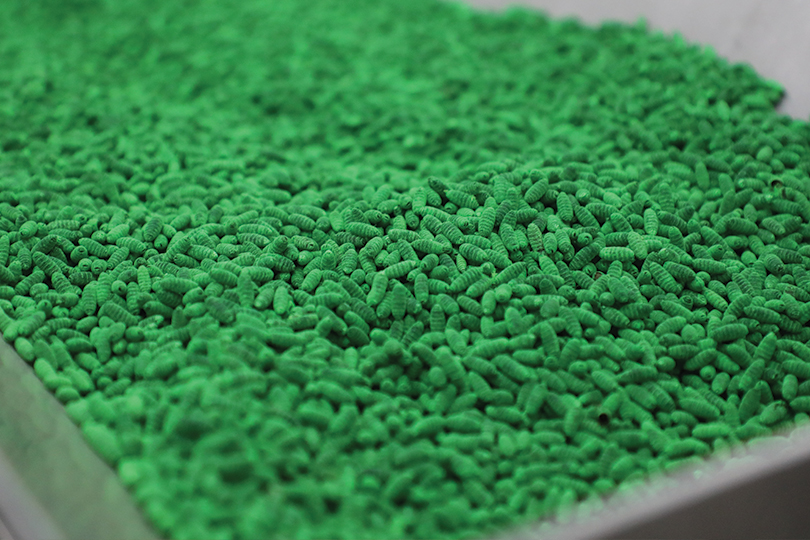
After the dye is applied, the pupae are measured and evenly disbursed into trays stacked inside large emergence towers.
Those towers are then placed into a climate-controlled emergence room designed to mimic natural conditions. The temperatures in the room range from 82 to 90 degrees and humidity between 50% to 80%.
Once the flies emerge, the towers are moved into a separate cooling room kept near 37 degrees. The colder temperature places the adult flies into a dormant state to make them easier to handle and transport for dispersal operations.
Ground dispersal
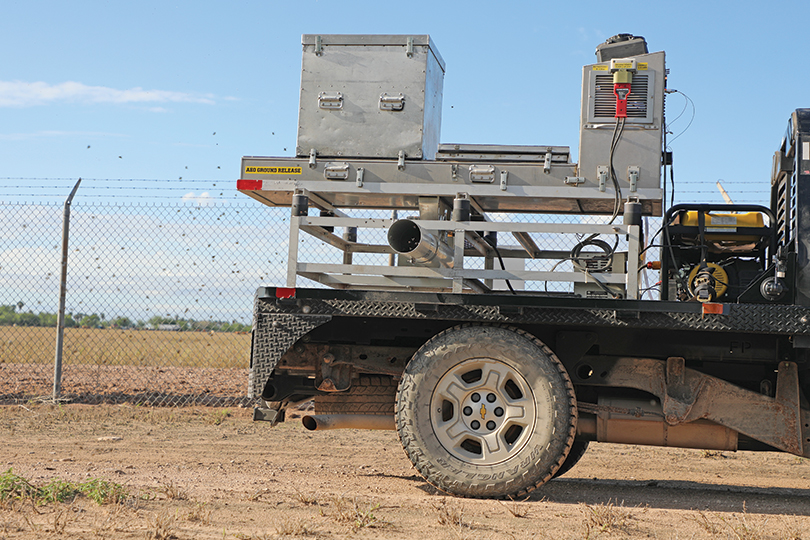
During ground release, a truck slowly drives through a designated route while releasing the sterile flies.
“They start falling into these augers, and then they get blown out through the pipe that comes out of the ground release truck,” Cruz said. “Right now, we’re dispersing between 36 to 38 liters of flies, which comes out to roughly 250,000 sterile flies.”
The truck travels about 10 miles per hour while dispersing the flies across targeted areas.
“For every one fertile fly, we want to see at least 10 sterile flies that we’re releasing,” Cruz said.
Texas Farm Bureau’s role
TFB continues working with state and federal officials on response and preparedness efforts, including supporting efforts with Congress and USDA to strengthen domestic sterile fly production and dispersal capacity in the United States.
“Expanding sterile fly dispersal and strengthening domestic response capabilities are key steps in slowing the movement of New World screwworm and protecting livestock, wildlife and animal health,” said Tracy Tomascik, Texas Farm Bureau (TFB) associate director of Commodity and Regulatory Activities.
Additional response operations are also underway in Mexico. The country is conducting aerial releases across affected regions and has implemented movement restrictions and animal inspections.
“The collective response efforts between the U.S. and Mexico have proven effective at slowing down screwworm expansion,” Tomascik said. “It’s critical that everyone remains vigilant and reports suspected cases to officials, because that’s the fastest way to respond and eradicate a population.”
Gov. Greg Abbott also expanded the disaster declaration related to the threat of screwworm, and Texas agencies are coordinating response plans with livestock groups and federal officials.
For more information and to view the current situation map of the latest NWS detections, visit screwworm.gov.
Leave A Comment