
By Emmy Powell
Communications Specialist
Agritourism continues to expand across Texas, offering visitors opportunities to experience life on farms and ranches through seasonal events, educational tours and outdoor recreation.
But as more landowners open their gates to the public, taking the steps to manage liability, including posting required signage, has become increasingly important.
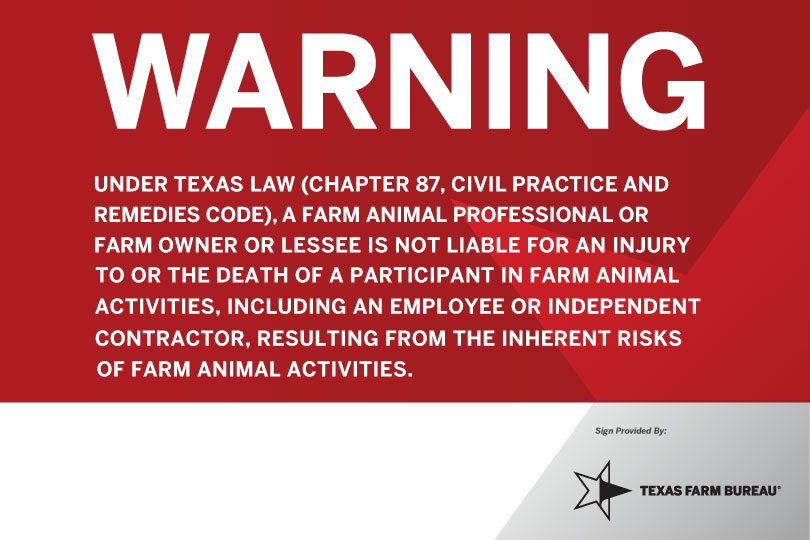
Under Texas law, two statutes provide limited liability protections for landowners: the Texas Agritourism Act and the Texas Farm Animal Liability Act (FALA).
Both laws require specific warning signs to be posted.
Recent court decisions in other states have brought new attention to the issue. In Virginia, a 2026 trial court ruling found that simply placing a sign at the entrance of a property was not enough to meet the requirements of that state’s agritourism law.
Instead, the court held that signs must be posted at each individual agritourism activity. A similar conclusion was reached by a Washington appellate court in 2023, where the lack of clear signage tied to a specific activity weakened the landowner’s legal defense.
“The language in the Virginia Act is identical to the language in many similar acts across the country. The court found that to meet the notice requirements under the Act, a separate sign must be placed at each separate agritourism activity, necessitating dozens of signs or more in many instances,” attorneys Jesse Richardson and Tiffany Lashmet said in a recent blog.
While these rulings are not binding in Texas, they raise important questions for farmers and agritourism operators across the state.
“Time will tell. Neither the Virginia ruling nor the Washington Court of Appeals decision are binding on Texas. Although similar, every state’s agritourism law has different language and may be interpreted differently by that individual state’s court,” Lashmet said.
The Texas Agritourism Act, passed in 2015, allows landowners to limit liability by either posting a clearly visible warning sign or requiring participants to sign a liability waiver.
The statute specifies that signage must be placed “on or near” the premises where the activity occurs, but it does not define how many signs are required or whether each activity needs its own notice.
To date, Texas appellate courts have not provided further clarification.
Similarly, FALA requires signs to be posted in a “clearly visible location” near areas where farm animal activities take place, such as stables, corrals or arenas. However, the law does not address situations common in Texas, such as open pastures, leaving ranchers to interpret how best to comply.
Despite the lack of definitive guidance, agricultural experts emphasize the importance of taking a cautious approach. Posting multiple signs in highly visible areas—particularly near each activity—may help ensure that landowners can rely on these liability protections if an accident occurs.
“Agritourism operators should consider placing the required warning signs at each agritourism activity to ensure that the state act protects the activity. As one agricultural lawyer stated, ‘signs are cheap, lawsuits are not,’” the blog said.
Texas Farm Bureau offers compliant agritourism liability signs and FALA signs to help landowners meet statutory requirements.
These signs include the exact legal language required to notify visitors of potential risks.
The signs are available in plastic and metal.
They may be purchased online through the TFB Store at texasfarmbureau.org/store.
After clicking on the “member” link, you will be prompted to enter your MyTFB account information to proceed. If you don’t have an account, you can create one by clicking on the “Create Account” link.
Signs can also be purchased through your county Farm Bureau office.
TFB also has custom gate signs and private property protection signs available. For more information on these member benefits and others, visit texasfarmbureau.org/memberbenefits.
Get more information on FALA in this frequently asked questions document developed by AgriLife.
I own a farm, my driveway is a pond dam coming into our property. Several people over the years have come out to our place to go fishing. Will the signs help protect me in case of and accident? Cattle could be in the same pasture when they are fishing. But what if someone drowned or was bitten by a snake?