
By Emmy Powell
Communications Specialist
Farmers and ranchers are encouraged to scout their fields after spring rains and mild temperatures create favorable conditions for armyworms.
Although widespread outbreaks are more common in the fall, current conditions are setting the stage for population growth in parts of the state.
Improved soil moisture and strong forage production—primarily on bermudagrass, ryegrass, fescue and bluegrass—can attract the egg-laying moths and support developing larvae.
“Now is the time for farmers and ranchers to be scouting, not when damage is already visible,” said Tracy Tomascik, TFB associate director of Commodity and Regulatory Activities
The pests feed on grasses and forage crops, causing more damage as they mature.
Most plant consumption occurs during the final larval stages when caterpillars can rapidly strip foliage.
“They can go from barely noticeable to causing significant damage very quickly,” Tomascik said. “By the time you see large caterpillars, most of the feeding has already happened.”
Armyworms are named for their tendency to march in large numbers across fields in search of forage. Though this behavior is more common during heavy infestations, it can still occur when localized populations build.
As ranchers prepare for summer hay production and grazing, regular scouting is critical. Armyworms are most active during early morning and late evening hours but may remain active longer during cloudy or mild conditions.
Experts say early damage is usually overlooked.
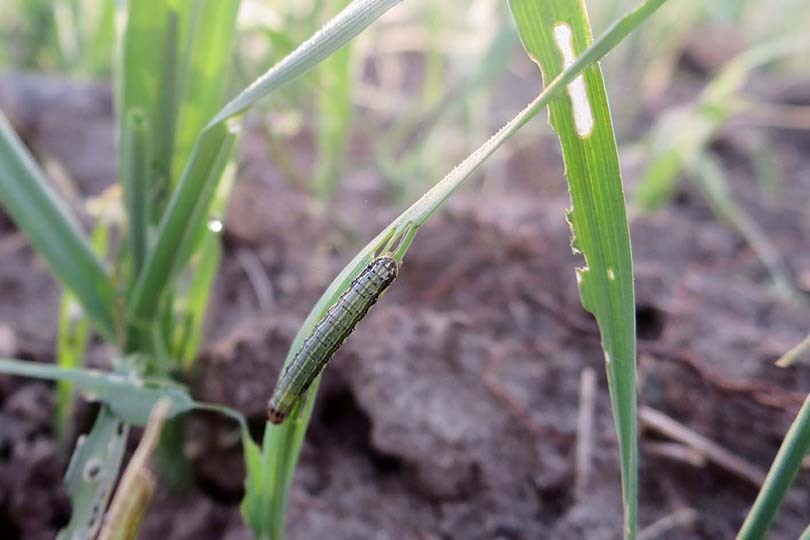
Looking for early signs of feeding, including ragged or scalloped leaf edges and thinning stands, near the base of plants is recommended.
Early damage may resemble drought stress before progressing into more severe defoliation.
“They are present long before we notice them,” Tomascik said. “Routine scouting is the best way to catch a problem before it turns into a major loss.”
Armyworm development is closely tied to weather patterns. Periods of rainfall followed by warm temperatures create ideal conditions for egg laying and larval growth.
“It only takes the right combination of moisture and temperature to set things in motion,” he said. “When those conditions line up, populations can increase quickly.”
A range of insecticides are available for use in pastures and hayfields. Farmers and ranchers should follow all label directions when making applications. In some cases, multiple treatments may be needed as new generations emerge.
For more information on armyworm management, view AgriLife’s free Fall Armyworm – Identification and Control booklet.
Leave A Comment