
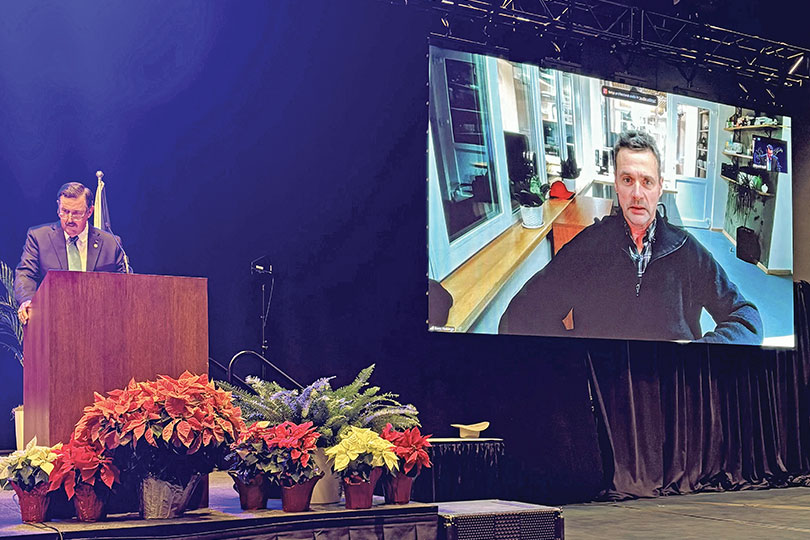
Texas farmers and ranchers heard from Ukrainian farmer Kees Huizinga via a live Zoom visit during Texas Farm Bureau’s (TFB) 92nd Annual Meeting where he offered attendees a unique perspective of what it’s like farming in a war zone.
Huizinga has been farming in Ukraine since 2003 and grows onions, carrots, wheat and canola, as well as manages a modern dairy farm.
But for the past several years, farming has been difficult as Russia continues its invasion.
“Every day, I’m glad to still be alive and to be healthy. That’s the most important thing in life,” Huizinga said.
When the war shut down Ukraine’s export routes three years earlier, grain prices decreased to $90 per metric ton, and at the same time, input prices were increasing.
However, his mix of row crops and the dairy provided multiple revenue streams when prices weren’t ideal.
Over the last year and a half, Ukraine has regained enough control of its ports to start exporting again.
“The grain can ship more or less freely in and out of Ukraine now,” he said. “Prices are back up again to $200 per metric ton. That’s a big positive change for us. We’re making money again and able to invest that in our dairy and buy new machinery to replace old equipment.”
Continuing to invest may seem unusual during a war, but Huizinga believes it’s necessary.
“I’m not sitting in the trenches, but I’m trying to continue my farm and make money so we can pay taxes to support the state, so the state can buy more weapons to defend ourselves,” he said.
Huizinga’s farm has been able to avoid direct hits so far, but danger remains close as the frontlines are only 200 miles from his farm.
“We have 600 to 800 drones and rockets in the air per night,” he said. “Many fly over our farm, and they wake me up. But luckily, none have landed on our home or damaged anything here.”
Huizinga shared a story about how there are a few crater marks where drones have fallen in his fields. He recalled watching an F-16 pursue a drone before downing it, sending debris into a nearby field. He said it’s not uncommon to find wreckage of a drone, some nearly 20 feet wide with intact warheads.
While Huizinga is not at the frontlines, several of his employees are. Some have been killed, and others remain missing.
Energy reliability has also become a major challenge. Increased attacks on civilian and critical infrastructure such as energy plants have led to frequent power outages.
Huizinga has had to install generators, large-capacity batteries and backup systems to maintain power to keep his dairy farm operating.
Huizinga also noted many small towns near the border no longer have functioning shops, leaving families there to depend on military convoys to deliver basic food and supplies every other week.
Despite intensified attacks, Huizinga remains hopeful the war will end soon.
“We’re still hoping for a peace deal,” he said. “It depends on Russia and on Putin, but the pressure is on them. We don’t know when it’s going to end, but we’re hopeful.”
Huizinga’s appearance was facilitated by the Global Farmer Network.
The live visit with Huizinga represented the third time TFB members have connected with the Ukraine farmer. Huizinga previously visited twice with TFB members in 2022.
Leave A Comment