
By Julie Tomascik
Editor
Texas Farm Bureau (TFB) called for sustained vigilance and strong agency coordination this week as state lawmakers received an update on the threat of New World screwworm.
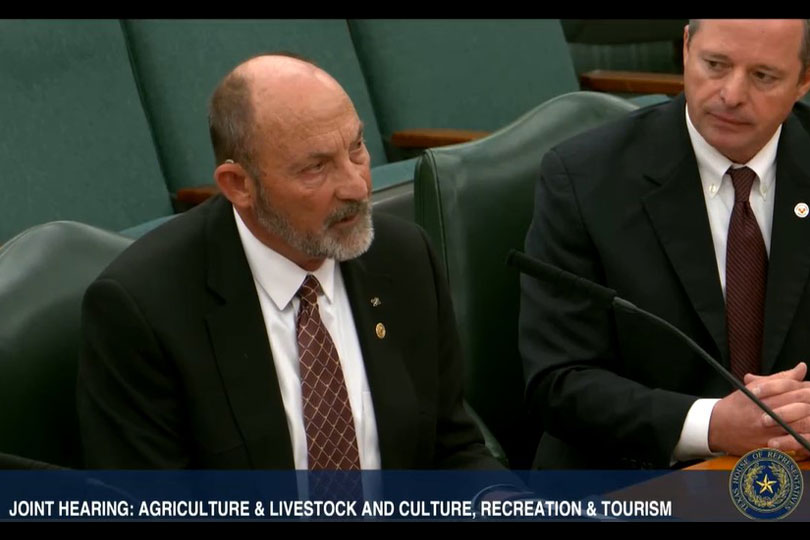
During a joint hearing of the Texas House Committees on Agriculture & Livestock and Culture, Recreation & Tourism, Dr. Greg Buenger, DVM, a TFB state director and large-animal veterinarian from Young County, testified about the severe risks posed by the pest and the urgency of maintaining a statewide response system.
Although no screwworm cases have been detected within Texas, the pest has repeatedly surfaced in northern Mexico, including detections just 70 miles from the border.
The state’s emergency screwworm plan leans heavily on quick reporting, coordinated surveillance and treatment protocols to help contain an outbreak before it gains a foothold in Texas.
“I’m old enough to have experienced the New World screwworm firsthand,” he told lawmakers.
TFB voiced strong support for the Texas Animal Health Commission (TAHC) and Texas Parks and Wildlife Department (TPWD), which are jointly leading surveillance and public outreach. Buenger said both agencies have worked closely with veterinarians, ranchers, hunters and landowners to help Texans identify symptoms of infestation and report concerns promptly.
Buenger urged lawmakers to reinforce that message with constituents across rural and urban communities and to continue supporting the state agencies’ efforts.
“This system is critical for us to control this pest and its impacts on animals in Texas,” he said.
Buenger said that, in addition to supporting these agencies, access to approved pharmaceutical treatments or topical medications will be critical to minimize the damage from this pest.
Some products have received emergency authorization, but Buenger noted that additional medications will need rapid evaluation to ensure they are both safe and effective.
“Off-label or unapproved use of animal drugs can jeopardize food safety, violate federal regulations, and compromise international trade,” he said. “It is imperative that all therapeutic interventions follow FDA guidelines and undergo proper regulatory review before being recommended or distributed.”
Buenger also pointed to major federal investments now underway to strengthen the U.S. response.
The U.S. Department of Agriculture (USDA) committed $750 million to build a sterile-fly production facility in the Rio Grande Valley, which will eventually release up to 300 million sterile flies per week.
A distribution facility is expected to open in the Valley in early 2026, and the agency dedicated another $100 million to research and development of new tools and technologies that will aid in the response.
The economic stakes are high.
A screwworm outbreak in South Texas in 1976 cost the state more than $330 million. Adjusted for inflation and current cattle prices, USDA estimates that a similar outbreak today could lead to more than $1.8 billion in annual losses for Texas livestock producers alone, and over $10 billion nationwide.
The pest also poses an enormous threat to wildlife, like white-tailed deer, which contribute $9.6 billion in economic activity to the state each year.
“This is not just an agricultural issue. It’s a matter of national biosecurity,” Buenger said. “We must be prepared.”
TFB commended the coordinated efforts of state and federal agencies and urged continued funding, public awareness and science-based response strategies to keep Texas screwworm-free.
USDA, TAHC and TPWD, along with other landowner and agricultural groups, also provided comments during the hearing.
For more information on New World screwworm, visit screwwormtx.org or screwworm.org.
Leave A Comment