
By Jessica Domel
Multimedia Reporter
The nation’s capital may be hundreds of miles from the shores of the Red River and the fields Texas farmers call home, but that has not stopped producers in the Lone Star State from having a voice in Washington, D.C.
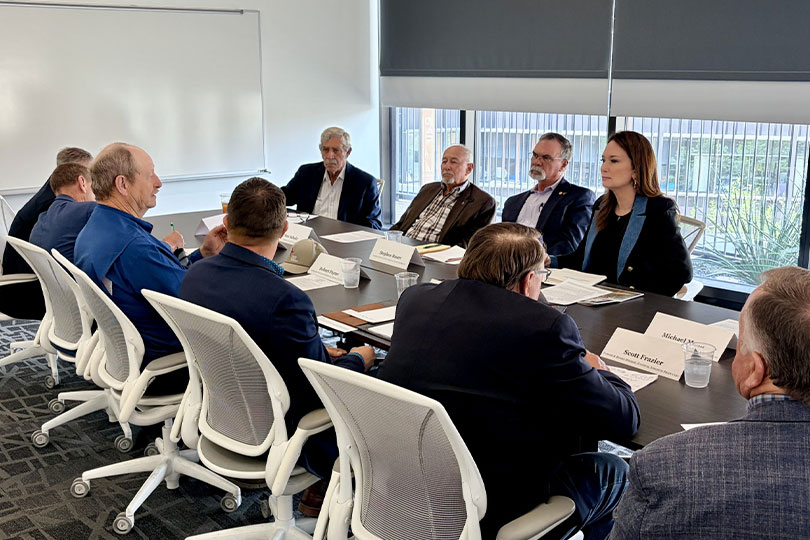
A group of Texas farmers and ranchers sat down with U.S. Secretary of Agriculture Brooke Rollins April 9 in Austin to discuss some of the issues facing agriculture, including how higher fuel and fertilizer prices are taking a toll on farmers while commodity prices remain low. The roundtable was coordinated and organized by Texas Farm Bureau and brought in other key Texas agricultural organizations.
“We had representatives from all over the state, from Corpus Christi to the Panhandle to Northeast Texas, Central Texas to the Hill Country. We had good representation across the state of row crop farmers and small grain farmers and cattle ranchers,” Michael Moon, Texas Farm Bureau District 8 state director, told the Texas Farm Bureau Radio Network. “She wanted to know a little bit about everything that’s affecting us now, from fuel to fertilizer to anything else that the cost has gone up.”
Fuel and fertilizer prices rose recently as a result of the war in the Middle East. Iran has cut off access to the Strait of Hormuz, a vital chokepoint in the region, restricting the movement of oil and fertilizer from countries in the Persian Gulf, west of the strait.
“We had our tanks topped off in the U.S., and as soon as the war started, the price started going up,” Moon said. “I don’t know why they want to do that to us when we’re hurting already as farmers and ranchers. To me, that’s gouging really. I understand they have to replace it at some point in time, but when you have to replace a truckload of fuel, 7,500 gallons at $6 a gallon, that hurts.”
Prior to the conflict, fertilizer prices were already trending higher due to China restricting exports to ensure its own domestic availability, European producers cutting output due to the loss of a cheaper Russian gas supply and countervailing duties placed on imports of phosphate fertilizer imports from Russia and Morocco.
The restricted access to the Strait of Hormuz then sent those prices even higher.
“We mostly talked about the war and its effect. Everyone at the table, we all thought the same thing. We get less than 1% of our fuel from over in that part of the world, and we get very little of our fertilizer from over there. So, how could that affect us so bad here?” Moon said. “It’s speculation in the markets. That’s what’s driving it.”
Moon said while prices for inputs, like fertilizer and fuel, have gone up, the prices farmers receive for their crops have stayed flat.
“You can’t hardly sell any corn right now. There’s no buyers. They definitely do not want last year’s corn. This year’s corn, there’s no contracts on it,” Moon said. “They haven’t gone up any at all to offset anything. The only thing that halfway offsets our cost is if you run cattle, cattle are bringing record prices, but that’s offsetting our little losses.”
The rising cost of fertilizer isn’t just hitting corn, sorghum and cotton farmers.
“Add in anybody that’s a hay producer. We just fertilized hay last week because we had rain chances that came in, and our fertilizer was up 25% just on our grass patches that we were fertilizing,” Paul Minzenmayer, TFB District 7 state director, told the TFB Radio Network. “I told her we’re just a few months away from purchasing our fertilizer for our next wheat crop that we’ll be putting in in the fall.”
Minzenmayer noted he’s looking at a 40% increase in fertilizer costs for the upcoming wheat crop that will be planted in the fall.
“It looks very grim,” Minzenmayer said. “If we don’t put out fertilizer, then yields are down, but we have to have a product to sell in order to continue farming.”
Farmers aren’t the only ones being impacted by the higher prices. Their communities are feeling the pinch, as well.
“When you live out in rural America, freight is in so much of every expense. It’s in the cost of food and all the products. It costs more for a restaurant and then their customers have less money to spend because it costs twice as much to fill up your vehicle this week as it did a month ago. So, those dollars are being limited and tougher to spend,” Minzenmayer said.
Moon and Minzenmayer said the secretary took many notes during the roundtable about the farmers’ concerns and potential actions the administration may take to alleviate some of the pressure on farmers.
For example, TFB suggested the administration use presidential power to temporarily suspend the countervailing duties on imports of fertilizer to moderate price increases.
“They foresee that maybe Trump can, since we’re at war, temporarily restrain those,” Minzenmayer said.
TFB also suggested the administration do what it can to ensure port, rail and barge capacity is available to deliver fertilizer imports on time to the farmers who need it and leverage all federal tools available to ensure vessels are insured throughout their passage to America.
“I’m very hopeful. She seemed to really be respectful of our time and respectful of our thoughts. She took lots of notes, which makes you feel like you’re being heard,” Minzenmayer said. “She had staff there that was really listening and kept talking about conversations she would be having with Trump to try to help support us and support the ag industry.”
The group also discussed the $11 billion in Farmer Bridge Assistance Program payments the U.S. Department of Agriculture (USDA) is distributing now to help farmers get through to the time when updated farm bill reference prices go into effect.
Minzenmayer said some farmers noted their bridge payments did not help. Instead, they went directly to pay the increased costs for inputs.
He said the group did discuss the potential for any additional economic assistance through USDA due to higher input costs as a result of the war.
“It was somewhat discussed, but more roundabout of if something was done, how can it be done to where it was actually kept by the farmer and not inflated into the prices, whether it be seed, fertilizer, chemicals, John Deere or Case, farm equipment, because it seems like any payments they make to the farmers immediately just ship to the next person down the line,” Minzenmayer said.
The secretary also discussed beef prices.
“There was even a little talk about the president wanting to try to do something with the cattle prices to bring those down,” Moon said. “It sounds good on paper, but when you’re in the industry that we’re in, it’s going to hurt. We’ve struggled through many, many years of low cattle prices. Now, we finally start making a little money on cattle, and they want to take that away from us. That doesn’t work either.”
The secretary noted she has talked to the president and said beef prices are the bright spot on the balance sheet and where they need to be right now, Minzenmayer said.
Both Moon and Minzenmayer said they stepped away from the roundtable feeling like they had been heard by the secretary and her staff and hopeful that action could be taken to support U.S. agriculture.
“It’s amazing to be able to have that conversation so close to home with somebody from Washington, D.C., out here to listen to us and really feel like they care about us,” Minzenmayer said. “We didn’t have that same response, it didn’t feel like, from the previous administration. I’m really hopeful that some changes can be made to make it work better for us.”
Leave A Comment