
By Jessica Domel
Multimedia Reporter
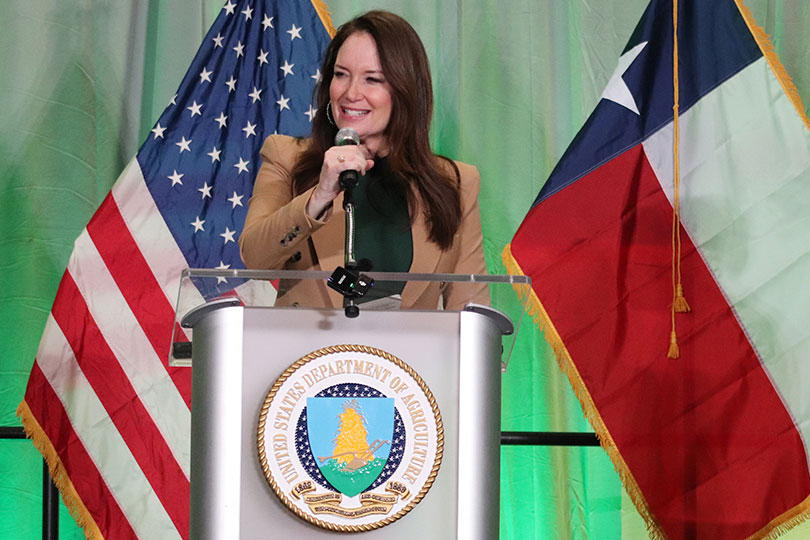
U.S. Secretary of Agriculture Brooke Rollins has made five key commitments to U.S. farmers intended to improve agriculture and the farm economy.
“First, we want to continue to deregulate and get the government off of your back,” Rollins told farmers at the Commodity Classic in San Antonio. “In just the last year, over the entire Trump administration, for every one new regulation, we have gotten rid of 129–many specific to our industry–saving the American people $211 billion.”
USDA also plans to reform the National Environmental Policy Act (NEPA).
“USDA is rescinding seven agency specific regulations and is issuing one set of department-wide NEPA regulations, resulting in a 66% decrease in burdensome regulations on you, our farmers and our ranchers,” Rollins said.
The Environmental Protection Agency (EPA), Rollins said, is continuing its work on the Waters of the U.S. (WOTUS) rule to ensure the country is no longer operating under two different definitions of what areas fall under federal jurisdiction under the Clean Water Act.
“EPA is clarifying, once and for all, the Waters of the U.S. rule or WOTUS to conform and ensure that the historic Sackett versus EPA SCOTUS decision is giving the relief and getting government off of the back of our farmers and ranchers in key parts of our country,” Rollins said. “I know in Texas there’s probably a little bit of this, but when I talk to some of our producers in the state of Washington or California, or some of the states where they don’t have quite as friendly of a supportive elected officials and administration, that it is absolutely destroying many of our family farms and ranches.”
EPA and USDA will also continue to work together to fight for farmers’ right to repair their own equipment, Rollins said. Just last month, EPA released guidelines to manufacturers on farmers’ right-to-repair under the Clean Air Act.
The second commitment Rollins made was to strike new trade deals.
“In the coming months, we will advocate on behalf of you, our American farmers, in the Philippines, in Manila, in Turkey, in Istanbul, in Australia, in New Zealand, in Saudi Arabia, and in Vietnam. That’s just in the next few months,” Rollins said. “We have to open up these new markets if we’re going to have a prosperous future for our agriculture community.”
The third commitment is to continue lowering input costs for farmers.
“Thankfully, they are starting to moderate. Some are even coming down as a result of this president’s policies,” Rollins said. “Fertilizer prices are forecasted to decrease 1.4%, not enough, but at least we’re going in the right direction. Seeds are forecasted to decrease 1.3%. Fuel is expected to decrease almost 7%, and pesticides are forecast to decrease 8.3%.”
Rollins said that’s good progress, but there’s still work to do.
“My commitment to you is we will never stop until we get our arms around why all of these inputs, so many have increased 20%, 30%, 40% at a time when our farmers are barely surviving,” Rollins said. “We will not rest until we get to the bottom of it, and we provide real solutions to you.”
The secretary said the administration will continue to leverage its deregulatory agenda to ease regulatory burdens that have driven up the cost of agricultural labor, starting with the H-2A guestworker program.
“Last fall, our Department of Labor issued their interim final rule that changed the methodology that was used to establish the adverse effective wage rate for the H-2A program,” Rollins said. “This one rule change alone will bring the cost of labor down more than 40% and save our farmers more than $2 billion in one year alone.”
USDA and the Department of Justice will continue to investigate potential price fixing or anticompetitive behavior that may be driving up other input costs, Rollins said.
The secretary’s fourth commitment to farmers this year is to expand markets for U.S. agricultural commodities at home, which includes biofuels sales.
“While the Trump administration has gone as far as we can to regulatorily provide emergency E-15 waivers, Congress must now do its job and pass nationwide year-round E-15 legislation to continue to drive domestic crop demand,” Rollins said. “We are doing everything we can to make sure the message is heard loud and clear on Capitol Hill that there is no excuse.”
Rollins noted the administration has also proposed the highest and most aggressive renewable volume obligation (RVO) proposal in history, which “once final will ensure our corn, soy and sorghum producers have the long-term certainty and demand stream domestically that is already helping lower consumer prices at the pump.”
EPA announced last week its renewable fuel standard has been sent to the White House. It’s expected to be finalized by the end of March.
“We are hopeful this will create a major increase in domestic demand for our great American crops,” Rollins said.
Her fifth commitment to U.S. farmers, outlined at Commodity Classic, was to double-down on strengthening the farm safety net as the administration continues to implement provisions from HR 1, also called the One Big Beautiful Bill Act.
“We look forward to a new farm bill in the very new future,” Rollins added.
The secretary said these commitments are important because food and farm security are national security.
“I want every American to understand that if we are not able to reverse the trend, the farm economy, the increase in inputs, the lesser markets around the world, protecting from lawfare, if we’re not able to reverse that trend, then we not only will lose the greatest industry in American history, but we will also lose our country,” Rollins said. “There is no freedom unless we are able to feed and fuel ourselves. That is how existential I believe this is.”
Leave A Comment