
By Shelby Shank
Field Editor
Texas farmers and ranchers are facing growing challenges as an unexpected new pest begins damaging hay fields and pastures.
“Last spring or the fall before, we noticed some yellow spots in our hay fields. It almost looked like somebody had been through there with a spot sprayer,” said Matt Chachere, a farmer and rancher from Liberty County.
At first glance, the affected areas appeared brown or reddish. Small circular patches started about one foot in diameter, then spread over days and weeks, eventually forming circles spanning five to 50 acres.
Unlike familiar pasture pests such as armyworms or maggots, the cause of the damage wasn’t immediately clear.
“We’ve dealt with armyworms and maggots in the past and know what insect damage looks like,” Chachere said. “It was obvious this was not a nutrient deficiency, but we performed a soil test, and the results came back normal.”
Chachere worked with local Texas A&M AgriLife Extension agents and crop specialists to discover what might be eating away his grass.
“It took a year to positively identify that they were mealybugs,” he said. “Our concern is that they’re causing our grass to not grow back. These pests are affecting our stand of Bermuda grass, and we worry we may lose it after planting.”
Pasture mealybugs are associated with a syndrome called “pasture dieback,” a condition that kills patches of pasture grasses. It’s identified by reddening or yellowing leaves like Chachere noticed, stunted growth and root reduction.
The pest was first confirmed in Texas this summer and has now been identified in nearly two dozen counties according to AgriLife Extension.
Infestations have devasted some Bermuda grass hay fields and other improved pastures.
“In one case, a 10-acre Bermuda grass field went completely brown and never came back,” said Stephen Biles, integrated pest management entomologist for AgriLife Extension. “That level of damage represents a real threat of losses for farmers and ranchers.”
Biles said pasture mealybugs have been found to damage a range of forage grass species, including Bermuda grass, Bahia and bluestem, as well as turfgrasses like St. Augustine.
Current insecticides labeled for pastures have shown little to no effectiveness against pasture mealybug, leaving farmers and ranchers with limited management options while research continues.
The pests’ full impact in Texas is still being determined, but experts say mealybugs have the potential to threaten forage production critical to Texas’ livestock industry.
Experts are also uncertain about the spread of mealybugs. They suspect the pest has spread via contaminated haying equipment and possibly hay bales, which raises concerns about broader distribution.
“We blow off our equipment every evening when we service, but I have a neighbor a few miles down the road that has some damage in his fields this fall too, and our equipment hasn’t been in the same fields,” said Chachere, who is a Liberty County Farm Bureau member.
AgriLife Extension specialists are working with the U.S. Department of Agriculture Animal and Plant Health Inspection Service and local producers to evaluate management strategies, study potential biological controls and provide updated recommendations.
“Right now, this is about awareness and monitoring,” Biles said. “Producers need to know what’s out there and to be watching for this new pest.”
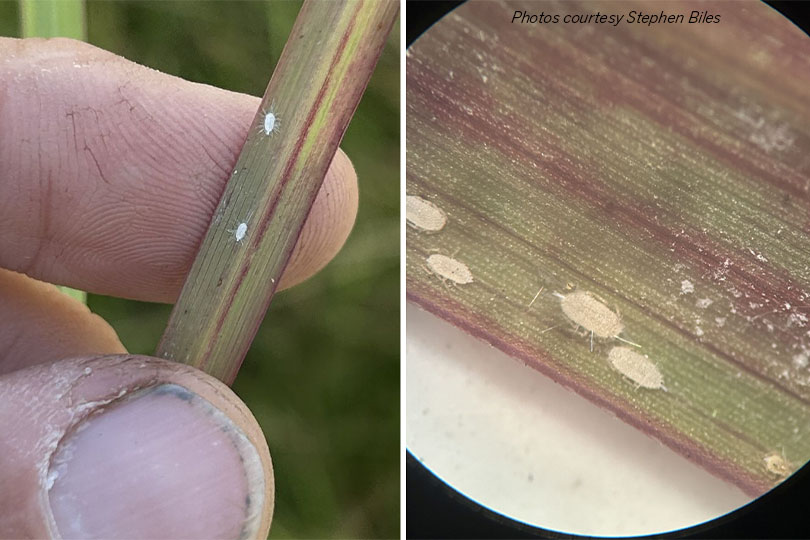
Most pasture mealybugs reside on the grass blades. The small insect is characterized as fluffy white, waxy or “fuzzy.” Specimens can be collected for species verification by AgriLife Extension.
For more information about pasture mealybugs, reference this fact sheet.
Leave A Comment