
By Julie Tomascik
Editor
The United States and Mexico reached an agreement last week to resolve a long-running water dispute, the U.S. Department of Agriculture (USDA) said.
Under the 1944 Water Treaty, Mexico is required to deliver 1.75 million acre-feet of water to the U.S. every five years, about 350,000 acre-feet annually, from six tributaries feeding the Rio Grande. The U.S., in turn, delivers 1.5 million acre-feet each year from the Colorado River.
The most recent five-year cycle concluded Oct. 25, 2025, and Mexico had only delivered about 880,000 acre-feet, less than half of what was owed.
The agreement between the two counties follows heightened diplomatic pressure in December when President Donald Trump threatened to impose a 5% tariff on Mexican imports unless Mexico began meeting its treaty obligations.
“Our Rio Grande Valley members have struggled for decades to maintain their family farming operations due to Mexico’s inconsistent compliance. ‘Enough is enough,’ is the message we delivered to the administration and Congress,” Texas Farm Bureau President Russell Boening said. “With the announcement of this new understanding, it’s clear they heard our voices, and for that we are grateful.”
Mexico agreed to deliver 202,000 acre-feet of water beginning this week and finalize a broader distribution plan by the end of January to repay its outstanding deficit from the previous water cycle.
“President Trump’s authorization to hold Mexico accountable is a game-changer. However, any new deal by Mexico must be honored and include full payment of the debt,” said TFB District 13 State Director Brian Jones, who farms in the Valley. “If I were in debt, to the equivalent of Mexico’s 800,000 acre-feet, my farm would be foreclosed on. The U.S. government must stand firm in its position that, if Mexico doesn’t deliver, it will be held accountable. Absent action, every day that passes without certainty results in more fallow acres. Status quo is not an option.”
Water shortages reshape Valley agriculture
Citrus groves have long been a defining part of the Lower Rio Grande Valley’s agricultural identity. But today, the region’s orchards, as well as other farms and ranches, are struggling without reliable water.
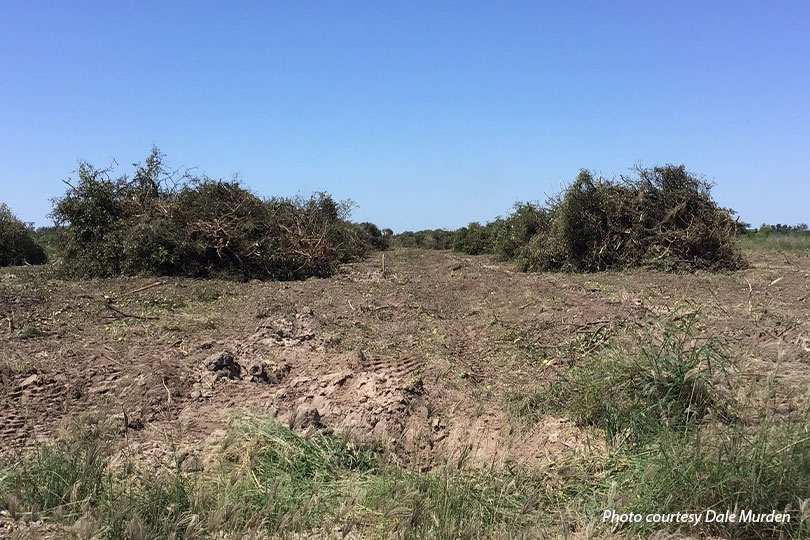
Thousands of acres of citrus groves have been removed, bulldozed and left fallow.
“It doesn’t make any sense to plant a tree if I can’t water it,” Dale Murden, president of Texas Citrus Mutual, said.
The loss of water has translated directly into fewer acres planted, fewer works employed and fewer dollars circulating through the regional economy.
“We’ve lost probably 8,000 to 9,000 acres overall in the last five years,” Murden said. “That’s taken the citrus industry to less than 20,000 acres for the first time.”
Without water certainty, even long-established growers face difficult decisions whether to remove groves altogether or shift to less water-intensive crops.
“Our quality is good. Our fruit is exceptional,” Murden said. “It’s a sought-after grapefruit. Unlike other areas of the world, our sweetness levels are superior. We have a great commodity if we can just hang in there and keep going.”
But citrus is a long-term investment.
A tree typically doesn’t start generating income over expense until about the fourth or fifth year, Murden said, making it tough to commit to growing the trees when there isn’t certainty that farmers will have water.
The uncertainty has already reshaped agriculture in the Valley, contributing not only to reduced citrus acreage but to the loss of the state’s only sugar mill.
While $280 million in grants from the U.S. Department of Agriculture provided some relief to Rio Grande Valley farmers, they said financial assistance alone cannot replace consistent access to water.
Treaty enforcement is essential
Mexico has historically relied on seasonal rainstorms to fill its reservoirs before making water deliveries to the U.S., but this strategy has proven unreliable during prolonged drought conditions.
In response, TFB voting delegates adopted policy calling for future trade agreements to include enforceable provisions and consequences for non-compliance with the 1944 Water Treaty.
Trying to stay optimistic
Despite years of frustration, Murden remains hopeful that water will once again flow through the Valley.
“Love what you do. It’s going to rain,” he said. “You have to have some faith that things are going to work out.”
For farmers in the Lower Rio Grande Valley, that hope now rests not only on rainfall, but on the federal government’s willingness to ensure Mexico follows through on its word.
Thank you TFB for pursuing this matter and pressing Washington to resolve it. Treaties are not made to be broken.