
New data shows that farmers’ share of the money consumers spend on food continues to shrink, even as prices rise.
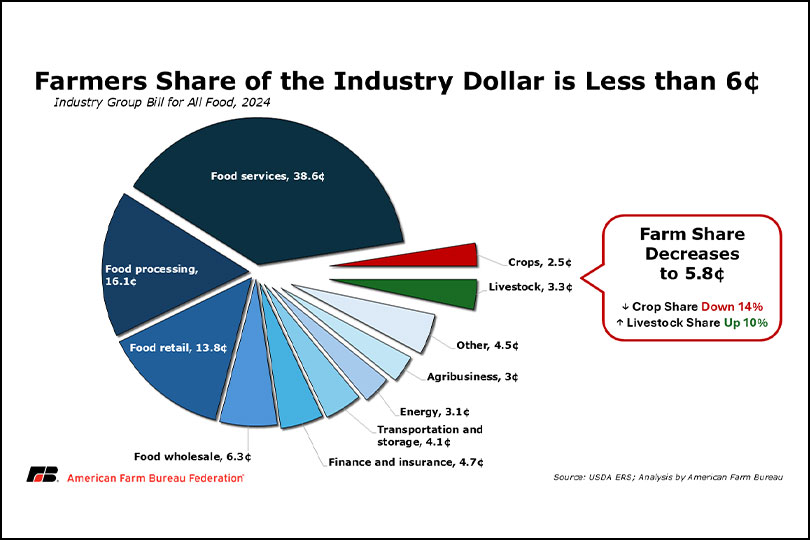
American Farm Bureau Federation (AFBF) economists analyzed data from 2024 that shows farmers and ranchers receive a combined 5.8 cents of every food dollar after accounting for expenses, down from 5.9 cents in 2023.
Crop farmers saw their share decline from 2.9 to 2.5 cents, while livestock producers experienced a modest increase from 3 to 3.3 cents.
The majority of the food dollar is attributed to food marketing costs incurred after food passes the farm gate.
“Taken together, the food dollar data highlight a fundamental reality of the modern food system: while farmers and ranchers are the foundation of food production, most of the economic value is created after products leave the farm,” Dr. Faith Parum, AFBF economist, said. “Less than 6 cents of total value added occurs at the farm level, while the marketing bill continues to expand as consumer spending increasingly reflects processing, transportation, retail and food service.”
The slight increase in share among livestock producers reflects a shrinking herd, which increases the value of cattle.
Historically low crop prices and increased expenses including fuel and fertilizer pulled down the share for crop farmers.
“America’s farmers and ranchers are the backbone of our country’s food system, yet they only see a small share of the total food dollar. While prices may be up at the grocery store, most farmers’ paychecks are shrinking,” AFBF President Zippy Duvall said. “Even modest swings in commodity prices or increases in expenses can quickly strain farmers’ finances to the breaking point. This imbalance must be corrected to create a brighter future for U.S. agriculture. The only alternative is reliance on other countries to feed America’s families.”
The Food Dollar Series, published by the U.S. Department of Agriculture’s Economic Research Service, tracks how each dollar spent by consumers on food is divided among the industries that contribute value along the supply chain. These industries include farming, food processing, transportation, packaging, wholesaling, retail and food service. As food moves through these stages, additional services, labor and infrastructure add value, and increase costs, to the final product.
Read the full Market Intel on the Food Dollar Series here.
Leave A Comment