
By Jessica Domel
Multimedia Reporter
Leaders from the U.S. House and Senate Agriculture Committees remain committed to finishing work on the farm bill and addressing agricultural labor, among other issues, this session of Congress.
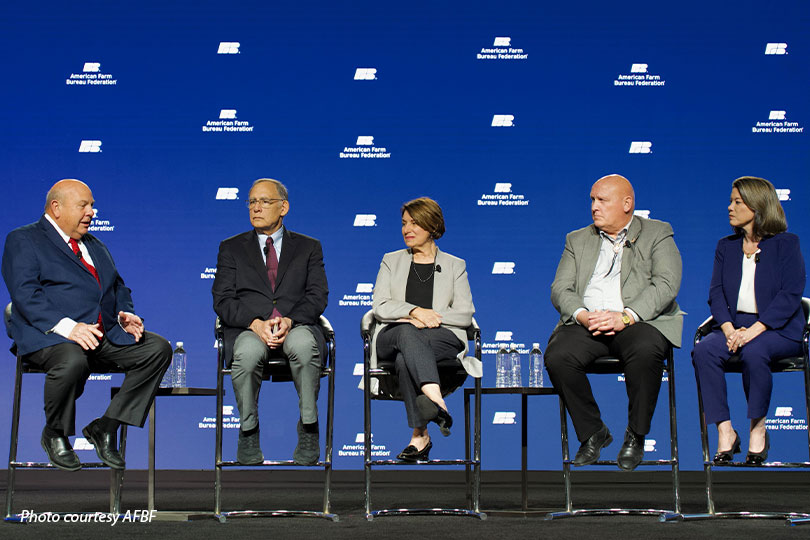
House Agriculture Committee Chairman Glenn “GT” Thompson (R-PA) and Ranking Member Angie Craig (D-MN), along with Senate Ag Committee Chairman John Boozman (R-AR) and Ranking Member Amy Klobuchar (D-MN), addressed farmers and ranchers from across the nation at the American Farm Bureau Federation’s (AFBF) Annual Convention Sunday in Anaheim, Calif.
“We were able to, in the Big Bill (HR 1), create a situation where we were able to help with the risk management tools that we all desperately needed to update and also several other things that are so important to agriculture to the tune of about $68 billion,” Boozman said. “We’ve gotten a majority of the farm bill passed. Now, we need to come back and finish that up. I’d like to work and get that done very shortly.”
Boozman said he’d like to address loan limits when it comes to farm bill 2.0, or the “Skinny Farm Bill.”
“These things don’t cost a lot of money. We got most of the cost drivers done, but now we’ve got to get things that help rural America—quality of life issues—and again, loan limits, where they work now with the inflationary period that we’ve had,” he said.
Klobuchar also wants loan limits addressed in the farm bill. She and Sen. John Hoeven have a bill Klobuchar said could be included in some sort of package that calls for improvements.
Thompson said although much of the farm bill was addressed through HR 1, or the One Big Beautiful Bill Act, there’s more work that needs to be done.
“We were able to make a significant investment, historic investment in agriculture, with what we did on trade and animal health and bringing down the cost of crop insurance and safety net, but there’s more left to be done,” Thompson said. “That 20% of investment that we need to do that’s left, it’s about 80% of the policies, and it’s so important.”
As for funding increased loan levels in farm bill 2.0, Thompson seemed confident they could find the funding to do so.
“I get my exercise turning rocks over in Washington within the agriculture space, and I’m pretty confident that we’re going to be able to identify that,” Thompson said. “That’ll be a part of what we release here.”
The chairman said they plan to get a farm bill 2.0 text out in plenty of time before the markup so members can look at it and really digest it.
“Pay-fors will be a part of that,” Thompson said. “Now, how much we find, how much we have, we’ll determine how far we can go with some of the things that I would like to do.”
Craig told the crowd she’d like to make sure the farm credit and rural development areas of the farm bill are taken care of, as well.
“I do hope that we can come to a bipartisan consensus on those two things,” Craig said.
In addition to finishing up the farm bill, Boozman said his priorities include holding hearings on what can be done to make agriculture more economically sustainable.
“Congress is stepping in and being helpful. I think they’re going to continue to do that, but we can’t depend on it,” Boozman said. “We’ve got to get ourselves in a situation where agriculture is sustainable. I’d like to have a couple hearings, bringing in the experts, bringing in you, the people that work at this all day, every day, telling us what you need, telling us the tools you need in the toolbox, whether it’s trade, figuring out a way to better use the products that we have here in our country, increasing domestic demand, value added products, the list goes on and on.”
Other priorities mentioned were year-round E-15 and biofuels and ag labor.
“Some reform on ag labor—I think we all know how hard this has been hitting our farmers. We’ve had a number of bipartisan ag immigration bills. I know that’s not an easy word to say right now in our country, but we know there are a lot of ways we could try to make sure that we have a stable workforce when it comes to agriculture, as well as other areas,” Klobuchar said. “That’s something, it feels far away, but I think it’s such a need right now. There’s possibility we could move on that.”
Klobuchar said reversing tariffs “would also be about the best thing we could do.”
“Then, we’re going to have to figure out how we adjust for that and make some of these payments and the like. I think that would be good long term. If that doesn’t happen, I hope the administration will back down on some of them for the sake of input costs and for the sake of the markets overseas and the like, or we can pass something in Congress,” she said.
Increasing markets for agricultural goods was also named a priority.
“We need more export markets in this country. We need more domestic markets in this nation,” Craig said. “I’m going to be looking for year-round E15, higher blends of ethanol and sustainable aviation fuel.”
The ranking member also named the cost of healthcare as one of her priorities.
“We have to be thinking about that. It’s not in our jurisdiction, but we haven’t brought up the cost of healthcare in this country. And I just want to say with 27% of farmers and ranchers across this country on some sort of Affordable Care Act plan today, the cost of healthcare is out of control, and we’ve got to figure out how we deal with it in this country,” Craig said.
For more coverage from AFBF’s Annual Convention, visit fb.org/news.
Leave A Comment