
By Shelby Shank
Field Editor
Persistent dry conditions across much of the state and limited rainfall in the forecast have ranchers concerned about hay supplies, grazing conditions and forage production this year.
Many ranchers like Dane Elliott are already digging into hay reserves while waiting to see what spring will bring.
Elliott raises cattle in Live Oak County and also custom bales hay in the area. In a normal year, one good cutting of hay yields between 2,500 to 3,000 round bales. When conditions allow for a second cutting, Elliott can easily reach 6,000 bales.
“This past year, I baled less than a thousand bales total, and that was off of one cutting,” he said. “I had 50 acres of hay grazer that I got one cutting off of, and it was a mediocre cutting of two bales an acre.”
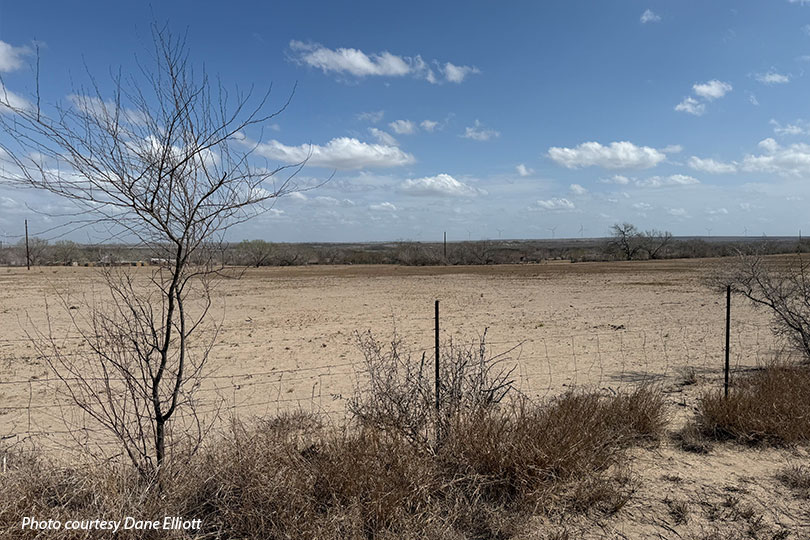
Conditions in both Live Oak County and neighboring Bee County have steadily deteriorated. While late summer and early fall rains helped grass growth temporarily, Elliot said the area hasn’t received good rainfall since last year.
“We haven’t had anything measurable since early December,” Elliot said. “The hay resources around us have really dried up. People have been looking for hay, and some have gone as far as El Campo or Wharton for hay supplies.”
Elliott ran out of hay in November and had to bring in additional bales from Hearne to feed his herd.
“People are having to travel a really long ways to find it,” he said. “This is as bad as I’ve seen it around us.”
Across the state, ranchers continue to deplete hay inventories, and the outlook for warm-season hay production remains uncertain.
Some ranchers may still have hay carried over from last year or even from the 2024 harvest, but the quality could be an issue.
According to the U.S. Department of Agriculture’s Texas Direct Hay Report, round bale prices currently average between $75 and $85, while premium round bales range from $110 to $145.
The bigger concern, though, is the lack of reserves.
“Usually, we’ll have a good year and then maybe a not so good year the next time, but we have reserves stacked up,” Elliott said. “The last three years, we’ve been very short on our hay supply. It’s really living year to year right now.”
Winter grazing has offered little relief. Without moisture, cattle are relying more heavily on hay and protein supplements.
Elliott has consolidated his cattle into larger groups to better manage feeding more efficiently and rest certain pastures, relying heavily on rotational grazing.
“I’ve learned in South Texas you always have to have a plan B,” he said.
Despite strong cattle prices, Elliott is reluctant to reduce his herd. Selling cattle now would bring a good return, but buying back into the market later could be costly.
The drought has also taken a toll on soil health. With minimal ground cover, some pastures have experience blowing sand and even topsoil loss. Elliott worries about whether his coastal Bermudagrass and native buffalo grass will rebound once moisture returns.
For now, all eyes remain on the forecast.
“All we can do is hope,” Elliott said. “We’ve been through a handful of droughts before. We know it’s going to come around and that it will eventually break.”
Leave A Comment