
By Shelby Shank
Field Editor
Cross-laminated timber (CLT) is an emerging building material that could open new opportunities for Texas’ forestry economy.
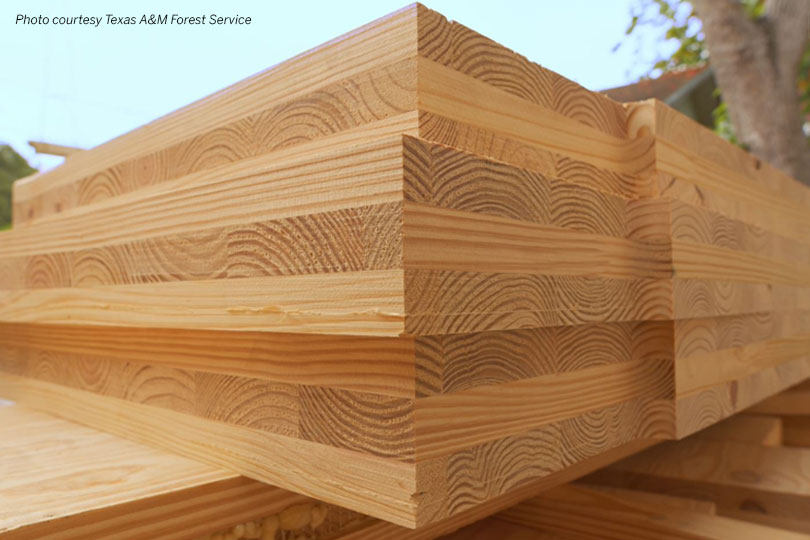
CLT is a type of mass timber that is created by bonding multiple layers of kiln-dried lumber like 2x4s and 2x6s. The lumber is glued or nailed together to make a modern version of heavy timber that gives the panels strength and stability.
The panels are manufactured off-site in controlled factory settings and are then transported to construction locations where they can be assembled quickly, reducing build times for projects.
CLT panels can be used for flooring, walls and roofs.
“Mass timber systems like CLT are particularly compelling because they lend themselves to offsite manufacturing, which is ideal for both rural housing and dense urban projects,” James Michael Tate, an associate professor at Texas A&M University, said.
Tate also noted that CLT’s high strength-to-weight ratio allows for lighter foundations and faster construction, while its natural wood appearance becomes a visible design feature.
CLT offers an alternative to traditional steel and concrete construction and is gaining significant traction driven by a surplus of timber in East Texas.
“Across East Texas, we’re growing nearly double the amount of timber we’re harvesting,” Dr. Aaron Stottlemyer, department head of Forest Analytics at Texas A&M Forest Service, said. “That surplus creates a need for new markets. Mass timber, including CLT, is one of the most promising avenues for utilizing that excess in a sustainable way.”
Stottlemyer’s team monitors forest growth and harvest rates across Texas and provides data for land management and economic development. He sees CLT as a key component in building a circular economy that supports private landowners, the forest industry, conserves working forests and reduces carbon-intensive construction.
With Texas’ already robust forest industry, mass timber would be an opportunity to bring new markets to Texas.
“Texas is 95% privately owned, and when markets slump, you often start to see forests converted to non-forest uses like shopping malls, subdivisions, things made with concrete,” Stottlemyer said. “Strong timber markets encourage landowners to keep their land forested and invest in stewardship. That’s good for the environment and the economy.”
Mass timber construction is still in an early adoption phase, but more than 130 mass timber projects are completed or underway across Texas.
Leave A Comment