
By Jessica Domel
Multimedia Reporter
Texas continues to lead the nation in New World Screwworm (NWS) research. The U.S. Department of Agriculture (USDA) has chosen to fund 13 NWS research projects in Texas as part of its NWS Grand Challenge.
USDA received 226 applications for funding through the challenge and chose 40 to split up to $100 million to support projects to enhance sterile NWS fly production, develop traps and lures, develop and increase understanding of NWS treatments and develop other tools to boost preparedness and/or response to NWS.
“We launched the Grand Challenge expecting bold, innovative and science-backed ideas to fight New World screwworm, and the proposals delivered just that,” U.S. Secretary of Agriculture Brooke Rollins said. “These projects represent the creativity, scientific rigor and determination we need to reinforce our existing efforts, empower our producers and safeguard American agriculture and our food supply. We have beaten this pest before, and by leveraging innovative solutions and advancements in technology, we will beat it again in record time.”
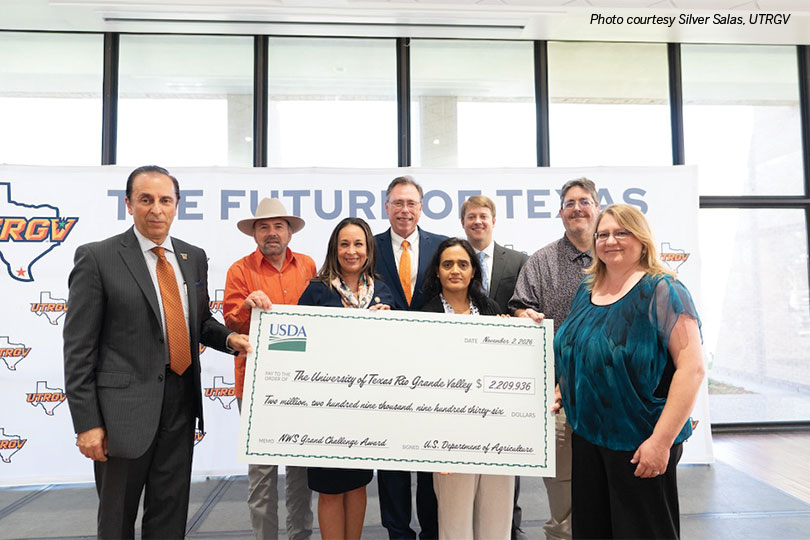
The University of Texas Rio Grande Valley (UTRGV) was awarded $2.2 million through the challenge for a two-year project led by Dr. Sarah Mays Maestas, assistant professor in UTRGV’s School of Integrative Biological and Chemical Sciences.
“This funding is going to be used to help develop new tools for screwworm monitoring and surveillance. One of the objectives of the research is to evaluate vegetation associations of screwworm flies using both native vegetation that’s common on the South Texas landscape, as well as some of the common introduced forages that are used, for instance, in cattle pastures,” Maestas told the Texas Farm Bureau Radio Network.
Based on those experiments, researchers will determine what habitats they suspect to be supporting NWS populations on the landscape.
Maestas said they can then “use that information to develop vegetation-based models of habitat use and their distribution in South Texas.”
The information would be used to evaluate where on the landscape NWS flies are to make management decisions, such as potentially identifying target areas for sterile male NWS fly releases.
“One of the other objectives of the research is to evaluate the use of thermal sensing coupled with machine learning to try to develop a AI-assisted method for thermal imaging detection of either infestations of screwworm fly in animals or potentially animals with wounds that would be targeted for treatment to prevent infestation,” Maestas said. “We’re especially interested in this for use in wildlife, but also other free-ranging animals, so it may have uses in livestock management, as well.”
UTRGV is hoping the tools will be able to improve NWS monitoring and surveillance methods.
“Ideally, these tools will be something that can be used by federal agencies like USDA or state agencies like Texas Animal Health Commission or Texas Parks and Wildlife, as well as producers and other individuals who are involved in that response to screwworm or making management decisions for trying to control screwworm,” Maestas said. “I think this should benefit individuals, particularly here in the South Texas region, but throughout those areas where screwworm is a threat.”
Texas A&M University was awarded about $4 million from USDA through the NWS Grand Challenge to study the genetics of NWS.
The two-year project will use samples from an ongoing NWS outbreak in Honduras to develop new tools for tracking and controlling the parasite.
Scientists at the Texas A&M College of Veterinary Medicine and Biomedical Sciences (VMBS), in collaboration with Texas A&M AgriLife and animal health officials in Honduras, will combine expertise in parasitology and genomics to study thousands of individual screwworms, creating what researchers expect to be the most comprehensive genomic analysis of the parasite to-date.
“We can sequence 99.99% of the screwworm genome in every single individual across time and across space,” Dr. Brian Davis, assistant professor in the Department of Veterinary Pathobiology, said. “That gives us a really powerful computational approach.”
The team will use samples to examine how screwworm populations are related across different locations and points in time. The project will take a broader approach than previous genetic studies.
“It’s going to be by far the largest genetic study of screwworm ever,” Davis said.
The genomic data could help researchers determine whether NWS populations carry genetic markers associated with resistance to drugs used to treat NWS infestations.
It could also help researchers eventually determine how NWS populations are related and trace where new outbreaks originated.
The data could reveal whether portions of the screwworm genome remain consistent across populations, potentially identifying targets for future drugs or genetic control technologies.
“We are going to produce the most comprehensive genomic analysis of the screwworm that we can use as a database to track new outbreaks and future outbreaks and to look back in time at how the population has changed or not changed,” Davis said.
The genomic data will be made available to other researchers after the analyses is complete.
The University of Texas at Arlington (UTA) received a $3.1 million award from USDA to develop an AI-powered smart trap capable of distinguishing between wild NWS flies and sterile ones.
It will also reportedly be able to distinguish between male flies and the females that are responsible for producing destructive NWS larvae, allowing earlier NWS detection in an area.
“This project moves screwworm surveillance beyond today’s ‘collect first, sort later’ trapping methods to AI-driven precision capture,” Dr. Shouyi Wang, UTA associate professor, said. “The smart trap is designed to recognize and selectively retain targeted wild screwworm flies, especially high-risk females, while releasing sterile flies and non-target insects back into the environment.”
The traps will be connected through a smart trap network, developed by UTA.
“Each detection can feed real-time alerts, location-based tracking and predictive risk maps that provide the USDA’s Animal and Plant Health Inspection Service (APHIS) with timely, actionable information for faster, more targeted responses,” Wang said.
The research will build on a previous AI-based fruit fly trap developed by Wang.
Field work for the project will take place across multiple states, including Texas, and NWS affected areas in Mexico.
“Our project aims to develop a real-time surveillance system and AI-enabled on-site diagnostic tools to support producers, veterinary practitioners and government agencies,” Prasanna Gowda, research professor and associate director of UTA’s Smart Agriculture Research Center (SARC), which leads the project, said. “Our proposed AI-enabled diagnostic tools will not only allow producers and veterinary practitioners to identify infections faster but also enable them to report directly to our real-time surveillance system with high-resolution images captured on their smartphones.”
UTA is also leading the development of AI models to power the smart traps. They’re developing the trap hardware, network, mobile reporting tools and web-based platforms for field reporting.
“Every earlier detection gives producers, veterinarians and animal health officials more time to act,” Wang said. “By combining smart traps, field diagnostics, real-time reporting and predictive analytics, this project is designed to turn field data into faster decisions and stronger protection for U.S. agriculture.”
Texas Tech University, Texas A&M AgriLife Research, Texas A&M’s Engineering Experimentation Station, Texas A&M’s Entomology Department and the University of Texas Medical Branch at Galveston will also receive funding from USDA for NWS research through the NWS Grand Challenge.
Leave A Comment