
By Emmy Powell
Communications Specialist
Researchers are studying how heat affects pasture mealybug feeding behavior in an effort to better manage the invasive pest threatening Texas pastures.
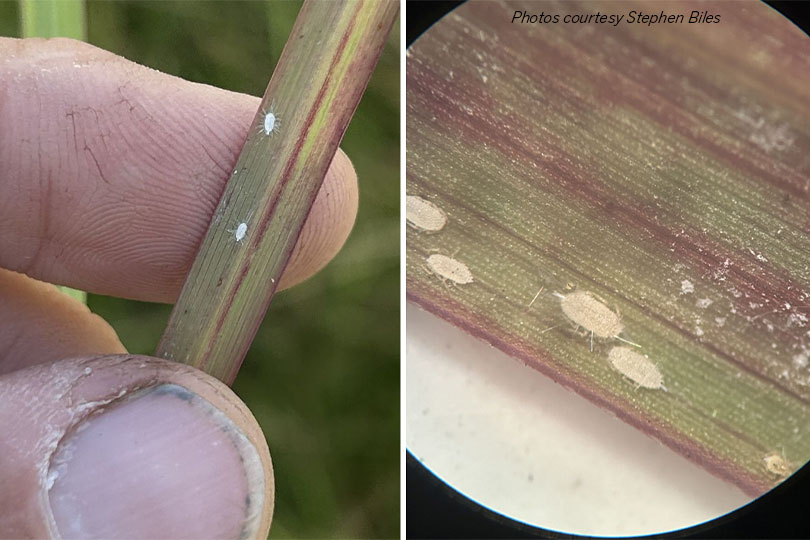
Pasture mealybugs have spread to 114 Texas counties since they were first reported in the state in 2025. The pest threatens native and improved grasses that support the state’s livestock industry.
Scientists with Texas A&M AgriLife Research have found that higher temperatures increase how frequently mealybugs salivate while feeding. Their saliva carries enzymes and toxins that damage plants, so increased salivation could contribute to more severe pasture damage.
Researchers are using a technique called electropenetrography, or EPG, to monitor insect feeding activity through electoral signals recorded by sensors attached to the insect and plant.
“It’s tedious work, but it’s exciting to know that what we are learning could make an impact and help people deal with this serious pest threat,” Ashley Zavala, a Texas A&M Department of Plant Pathology and Microbiology doctoral student, said. “If we can better understand what changes the way these insects feed, that’s a piece of the puzzle that can help guide management.”
The findings could eventually help farmers and ranchers better time pesticide applications by considering weather conditions, plant stress and insect feeding behavior.
Pasture mealybugs feed on plant sap and inject toxins that weaken grass, causing it to turn yellow, red or purple before dying. Severe infestations can kill large sections of pasture.
The insects thrive in hot, humid conditions and thick, tall grasses. Their populations can also increase following significant rainfall.
Dr. David Kerns, associate head of the Texas A&M Department of Entomology, said researchers still have many questions about the insect, including what environmental conditions contribute to population growth.
Kerns told the Texas House Agriculture & Livestock Committee in October that pasture mealybugs could cost Texas farmers and ranchers $2 billion annually.
Scientists with Texas A&M AgriLife Research have also evaluated pesticide options to manage existing infestations and are studying whether certain forage grasses are more resistant to the pest and how factors such as canopy density, heat, humidity and rainfall influence its populations.
Texas A&M AgriLife’s Emerging Pest Task Force is coordinating these research efforts across several disciplines to develop science-based management recommendations.
“Texas A&M AgriLife entomologists are tracking where pasture mealybug is, how populations move and how to control it, and forage researchers are examining which forage varieties hold up better under their stress,” Thomas Chappell, an epidemiologist in the Texas A&M Department of Plant Pathology and Microbiology, said.
For more information about pasture mealybugs, including how to identify infestations and available management options, visit the Texas A&M AgriLife Extension pasture mealybug resource page.
Leave A Comment