
By Emmy Powell
Communications Specialist
After months of dry conditions across much of Texas, a developing El Niño pattern could increase the chances for much-needed rainfall this winter.
Meteorologists expect the weather pattern to peak in intensity in late fall or early winter..
The National Oceanic and Atmospheric Administration (NOAA) reports a 90% chance of a strong event during fall and winter 2026-27.
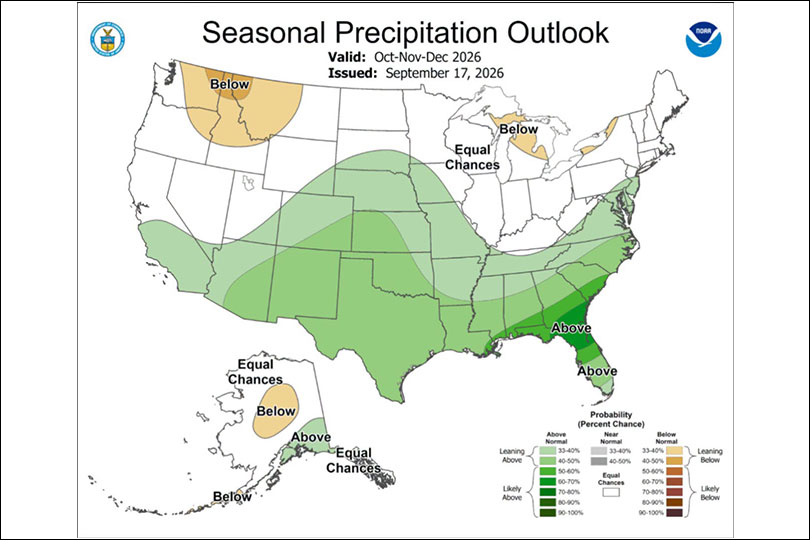
NOAA also forecasts increased chances for above-normal precipitation across much of the southern United States later this fall and winter.
“We do expect a greater amount of precipitation across the state of Texas than what we’ve been witnessing over the last several months,” Tom Bradshaw, meteorologist-in-charge at the National Weather Service, told the Texas Farm Bureau Radio Network. “So, there is hope for farmers, ranchers, all of us to live in the state of Texas as far as seeing some additional precipitation at some point as we get into the winter.”
The potential for increased rainfall could help ease drought conditions across the state, but Bradshaw expects conditions to worsen before they improve.
The latest U.S. Drought Monitor shows 96% of Texas is experiencing dry conditions.
“That situation is unfortunately probably going to get a little worse before it gets better as we move through September and October, even parts of November,” Bradshaw said. “It’ll remain on the dry side of things and on the warm side of things.”
The chances for beneficial rainfall are expected to increase as Texas moves deeper into winter, Bradshaw said.
NOAA’s seasonal outlooks show a wetter signal across the southern and central United States from late fall into early spring, a pattern commonly associated with El Niño.
But wetter-than-normal conditions are not guaranteed. The timing, location and amount of rainfall will determine how much drought relief Texas receives.
Tropical season continues
Texans should continue monitoring the tropics through the remainder of hurricane season.
Hurricane season runs through Nov. 30, and tropical development can still occur on short notice through September and into the first half of October.
“It only takes one storm to provide a lot of significant impacts to Texas,” Bradshaw said.
Leave A Comment