
By Emmy Powell
Communications Specialist
A newly developed strain of sterile New World screwworm flies could significantly increase the number of male flies available to help fight the pest.
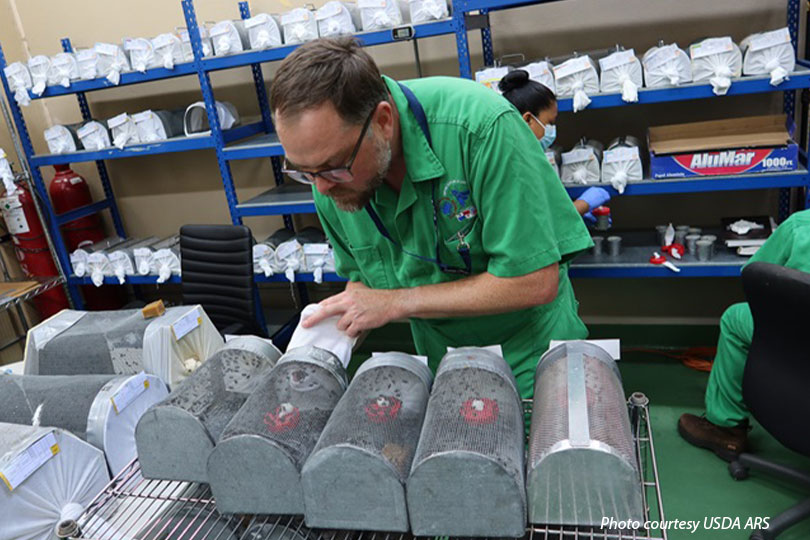
NovoFly™ is an all-male strain developed by U.S. Department of Agriculture’s (USDA) Agricultural Research Service (ARS) scientists and university collaborators. The strain is designed to make the Sterile Insect Technique (SIT) more efficient.
The SIT was essential in previously eradicating New World screwworm from the U.S.
“Releasing sterile screwworm flies is a proven, decades-old approach to eliminating populations of this pest and preventing the harm it inflicts—physically to livestock animals and wildlife and financially to the producers who raise livestock for our milk, meat, hide and other products,” Kim Lohmeyer, director of Knipling-Bushland U.S. Livestock Insects Research Laboratory, said.
The SIT involves releasing sterilized male flies near areas with screwworm infestations. The sterile males mate with wild females, but the resulting eggs do not hatch. Over time, repeated releases can reduce and eventually eliminate the screwworm population.
“Ultimately, the tool that’s going to knock this down once and for all is the sterile insect technique,” Dudley Hoskins, USDA undersecretary for Marketing and Regulatory Programs, told the Texas Farm Bureau Radio Network. “That’s what we used in the 1950s and ’60s to eradicate the screwworm from the United States.”
Current sterile fly production includes both males and females, although only the sterile males contribute directly to SIT by mating with wild females.
“A sterile male can prevent a lot of wild females from reproducing, but a sterile female fly that mates only once doesn’t help with SIT,” ARS Research Geneticist Alex Arp said.
Arp and other researchers developed NovoFly™ with a genetic switch that kills female larvae during the early stages of rearing but does not affect males.
Producing only males could essentially double the number available for release without major changes to existing production facilities.
“If we’re able to operationalize the NovoFly™, which effectively produces 100% male flies, that doubles our operational number,” Hoskins said.
USDA is working to expand sterile fly production as part of its response to New World screwworm. The COPEG facility in Panama is producing about 100 million sterile flies per week, and additional production capacity is being developed in Mexico and at Moore Air Base in Texas.
Hoskins noted the additional capacity, combined with NovoFly, could eventually put USDA at or above the approximately 500 million sterile flies used each week during the previous U.S. eradication effort.
NovoFly™ is not yet being used operationally.
Hoskins said researchers know the technology works, but they must determine whether NovoFly males can effectively compete with wild males for mates before the strain can be deployed on a larger scale.
“So far, everything we’ve seen on the field tests indicate that we’re making really good progress,” Hoskins said. “But until we have definitive answer to those questions, we really can’t risk trying to operationalize something.”
NovoFly™ is currently undergoing regulatory approval by the U.S. Environmental Protection Agency. Once approved, the strain could be used at designated screwworm rearing facilities.
USDA’s Animal and Plant Health Inspection Service coordinates the sterile fly efforts in the U.S, Mexico and Central America.
For more information about USDA’s efforts to prevent and prepare for New World screwworm, visit screwworm.gov.
Leave A Comment