
By Emmy Powell
Communications Specialist
Texas rice farmers are seeing lower yields from this year’s main crop, but good quality and a strong start to the ratoon crop are providing some optimism.
Early-planted rice yields are down about 5% to 15% compared to historical averages, according to Texas A&M AgriLife Extension Service. But slight improvements in yield and milling have been reported for rice planted in late March and early April.
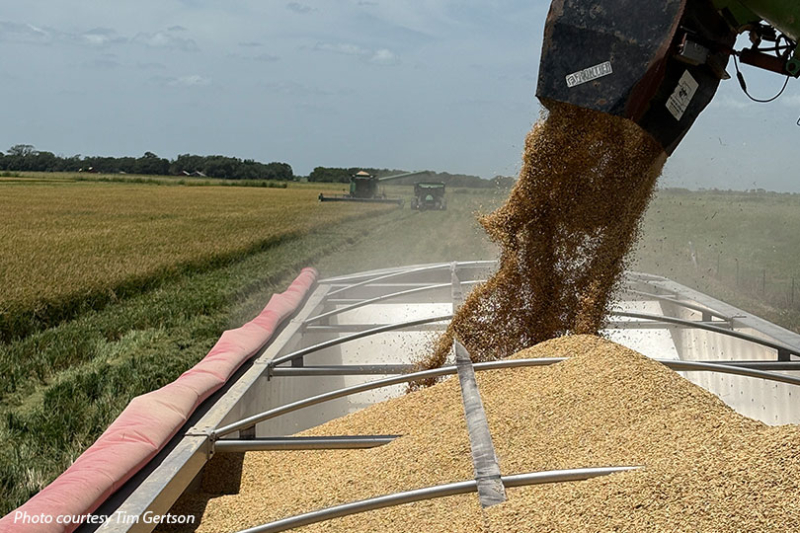
Tim Gertson, Wharton County Farm Bureau member and rice farmer, said yields on his farm have fallen short of expectations.
“Unfortunately, a lot of the earlier part of the rice yields were down, depressed pretty good across all varieties,” Gertson told the Texas Farm Bureau Radio Network. “That was just due to poor weather that we had during blooming and pollination.”
Increased rainfall and cloudy conditions during pollination contributed to this year’s yield reductions, according to AgriLife Extension.
Gertson said farmers were generally seeing yields 8% to 15% below what they would expect in a typical good year.
He planted jasmine rice exclusively this year and expected yields of about 7,000 pounds of dry rice per acre. Instead, his fields are averaging about 6,000 to 6,200 pounds per acre.
Crop quality, however, has been good.
“We had good, excellent harvest weather for the most part,” he said. “So, we’re expecting a very good quality rice crop.”
Delphacid pressure remains low
Rice delphacid was a significant concern following the 2025 crop, but AgriLife experts report infestations remain low across the Texas Rice Belt this year.
Sam Rustom, AgriLife Extension agronomist, said there has been no evidence of widespread economically damaging infestations, but localized activity has increased in some areas as harvest progresses.
“Continued field scouting remains important for early detection, particularly in fields entering the ratoon stage,” Rustom said.
Ratoon crop shows promise
Although the first-crop yields fell short of expectations, Gertson said conditions have been favorable for the ratoon, or second, crop.
“We have had a tremendous start to our second crop,” Gertson said. “The weather’s been great, lots of sun.”
Dry, firm field conditions helped protect the second crop’s yield potential. Gertson said harvesting in muddy conditions can reduce second-crop yield potential by as much as 30%.
“We’ve got a second crop that’s coming back that’s probably looked better than we’ve had in a long, long time,” Gertson said. “So, we’re really excited about the possibilities of a really great second crop.”
Leave A Comment