
By Shelby Shank
Field Editor
Dry conditions made for a challenging start to the growing season, but South Plains cotton farmer Brennen Johnson remains cautiously optimistic about this year’s crop. “This year is by far definitely a rollercoaster of waiting on rain,” he said.
Johnson, a third-generation farmer from Ropesville, grows cotton with his father and younger brother on about 12,000 acres. He also works as a sales agronomist, helping neighboring farmers navigate many of the same challenges his own operation faces.
“My dad started farming on his own in 1988, and ever since I can remember, I was with him on the tractor, spraying weeds with my grandpa and doing all that kind of stuff growing up,” Johnson said.
After graduating from Texas Tech University in 2015, Johnson knew he wanted to return to the family farm.
“With fewer families coming back to the farm around us and older generations not having anywhere to go, my dad has positioned our family as a reputable name in the area,” Johnson said. “I’ve always felt the responsibility to continue the legacy that my dad has worked so hard to build.”
That legacy is being tested this year by one of the driest starts to the cotton growing season in recent years.
The lack of spring rainfall prompted Johnson to begin planting irrigated cotton earlier than normal by pre-watering fields that were ready.
“Anything that was in decent shape, we pre-watered and did what we felt was right,” he said. “Those acres haven’t missed a beat since then.”
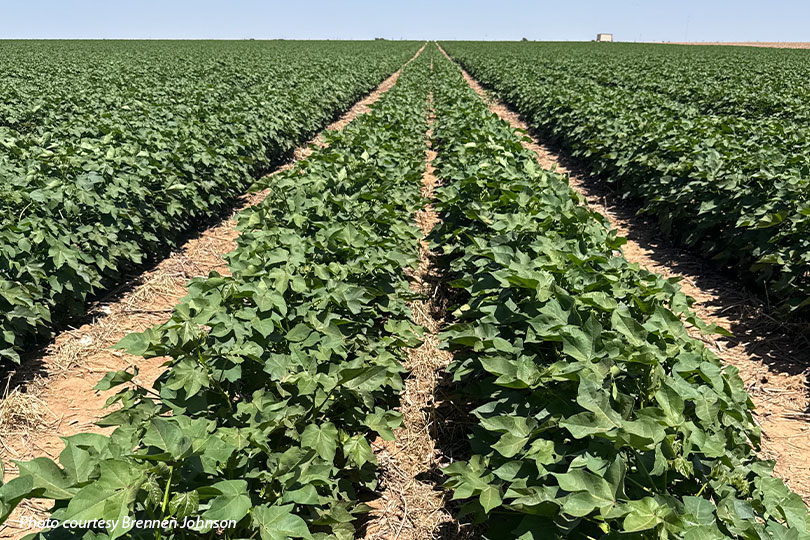
The dry weather also means fewer severe storms, and that allowed Johnson’s irrigated fields to develop into average or above-average stands.
His dryland cotton, however, has been a different story.
“Our dryland cotton without a doubt has been a huge struggle this year,” said Johnson, who is a member of Texas Farm Bureau’s AgLead XVII leadership class. “We finally have some stuff established, but it’s been a battle.”
About 10% to 15% of Johnson’s intended dryland cotton acres failed to emerge because of the dry conditions and will instead be replanted to grain sorghum after recent rainfall has provided enough moisture for planting.
Johnson said much of the region’s cotton crop is running behind schedule because farmers waited for enough moisture to plant.
“We’re going to need some good rain in July and August and hopefully a good late fall rain, too,” he said.
Additional rainfall and cooler temperatures in the forecast have provided renewed optimism.
Johnson doesn’t expect this year’s irrigated crop to match last year’s exceptional yields, but he believes there is still plenty of potential.
“I’m still optimistic for this year,” he said. “The crop isn’t stressed yet, and there isn’t anything that Mother Nature can’t provide over the next two weeks that’ll provide any more optimism than anything else could.”
Leave A Comment