
By Julie Tomascik
Editor
Federal and state responses to New World screwworm continue to expand as additional cases are confirmed, new resources are deployed and outreach efforts increase across Texas.
Additional cases confirmed
New World screwworm cases have increased since the initial detection in South Texas.
Animal health officials are conducting surveillance and trapping in affected areas while working to prevent further spread.
Livestock owners, veterinarians and wildlife managers are urged to inspect animals regularly and report suspicious wounds or infestations as quickly as possible.
Funding boosts response efforts
Texas recently secured additional federal support to strengthen its response.
Gov. Greg Abbott announced pre-award approval of a cooperative agreement with the U.S. Department of Agriculture (USDA) that will allow the Texas Animal Health Commission to hire 15 new term positions dedicated to New World screwworm response efforts. The positions include 10 field inspectors, along with emergency management and epidemiology personnel.
The additional staff will help expand surveillance, inspections and response activities.
Training more eyes in the field
A free New World screwworm inspector training program is now available to Texans who want to learn how to identify suspicious wounds, recognize signs of infestation and understand reporting procedures.
The training is designed for livestock producers, veterinarians, wildlife managers, animal health professionals and others who may encounter susceptible animals.
Officials say expanding the number of trained inspectors can help identify cases sooner and improve response efforts.
Grand Challenge funds awarded
Several Texas universities and research institutions will play a role in advancing New World screwworm detection, control and eradication efforts after being selected for funding through the USDA New World Screwworm Grand Challenge.
USDA recently announced about $105 million for 40 projects nationwide related to the pest.
Texas recipients include projects led by Texas Tech University, Texas A&M AgriLife Research, Texas A&M University-Kingsville, The University of Texas at Arlington, The University of Texas Medical Branch at Galveston and The University of Texas Rio Grande Valley.
In addition to the 40 newly funded projects, work is already underway on two other Grand Challenge initiatives.
Texas A&M AgriLife Research is evaluating electron beam technology as a non-radioactive alternative to cobalt-60 for sterilizing New World screwworm pupae.
Researchers at the University of Florida are also testing U.S.-made X-ray irradiators and using secondary screwworm as a surrogate to refine sterilization protocols.
Update shared with lawmakers
Texas Farm Bureau Vice President Warren Cude recently provided state lawmakers with an update on the New World screwworm situation and ongoing response efforts.
During testimony before the House Committee on Agriculture & Livestock, Cude discussed the threat posed by the pest, the importance of early detection and the need for continued investments in sterile fly production and eradication programs.
He also emphasized the value of coordination among federal and state agencies, livestock producers and agricultural organizations working to combat the pest.
Producer meetings
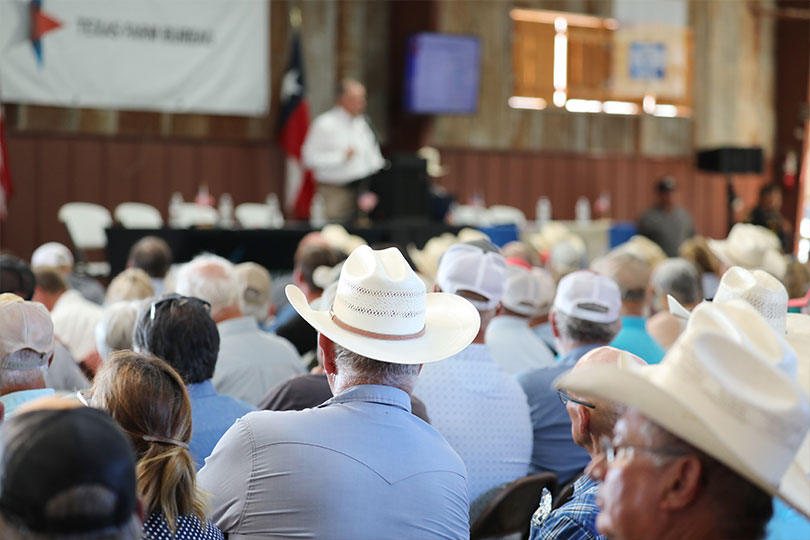
Several informational meetings have been held across Texas to keep livestock owners updated on the evolving situation.
The meetings covered surveillance efforts, movement requirements, treatment options and reporting procedures.
Producers have also had opportunities to ask questions and receive updates directly from state and federal animal health officials.
Officials stress that early detection and reporting remain critical to stopping the spread of New World screwworm and protecting Texas livestock and wildlife.
More information
For more information about New World screwworm response efforts, visit screwworm.gov.
For details related to infestation zones and movement restrictions, visit tahc.texas.gov/emergency/nws.html.
Leave A Comment