
By Emmy Powell
Communications Specialist
Rainfall across parts of Texas is creating challenges for hay producers, delaying harvest and, in some cases, affecting hay quality despite strong forage growth.
Cade Richmond, owner of Cade Richmond Hay, Land and Cattle, said the season in Comanche County started off promising.
“The grass came off for the first cutting in mid-May and looked pretty promising,” Richmond said. “But the rainfall has been just over the top, and that has now made for difficulty getting the crop out.”
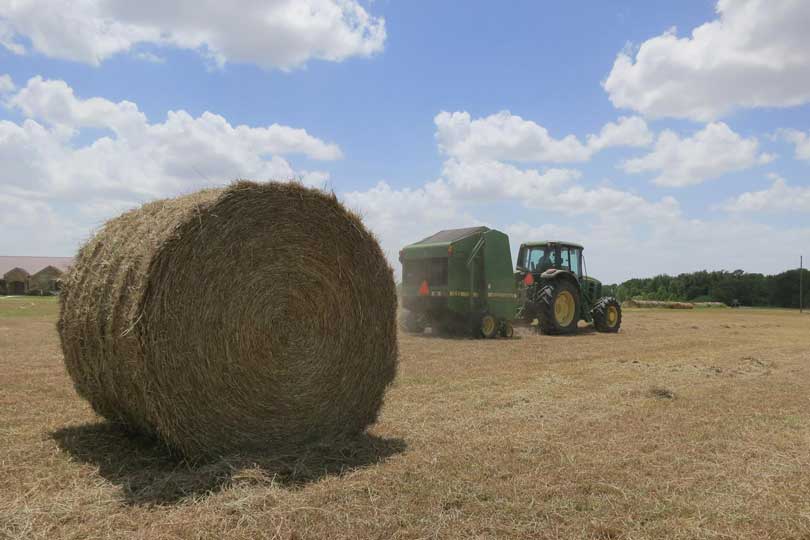
Many farmers have abundant forage, but frequent rain showers have limited opportunities to get into the field and harvest hay at the ideal stage of maturity.
“About the time we get our operation going, then we have to shut down for a rain,” he said. “We started strong, but we’ve had so many rain delays since then that it has really backed us up.”
The delays can affect quality.
“We try our very best to bale our hay every 30 to 35 days,” Richmond, who grows Bermudagrass, said. “Because of the rain delays, that’s extended out. So, the quality may sometimes be challenged, but we’re doing our very best.”
Farmers across much of the state have had a strong first cutting.
“There will be a large supply on this first cutting,” he said. “Everybody that was out there fertilizing and managing pests will have a very good first cutting.”
Pest concerns
Weather isn’t the only challenge this season. Farmers and ranchers are also watching for insect pressure.
Stem maggots are the primary concern for Richmond each growing season.
“If we do not spray preventatively for the stem maggot, it will affect our yield considerably,” he said.
Preventative management is key because once damage becomes visible, producers have few options.
“Unfortunately, once you see that you have them, it’s pretty much too late,” he said.
Another concern is the spread of pasture mealybugs. According to Texas A&M AgriLife Extension, detections have increased, and the pest has now been found in about 50 counties.
Armyworms and grasshoppers also remain on producers’ radar throughout the summer, although Richmond said grasshoppers have not been a major issue this year due to wet conditions.
Regular scouting is essential, though, because pest populations can change quickly.
“We try to monitor them closely,” he said. “Checking your fields daily is not too much because things change rapidly.”
Hay supplies
Richmond said this year’s hay outlook for much of the state remains favorable, thanks in part to carryover supplies from previous years.
“Both 2024 and 2025 were good years,” he said. “There’s been a lot of carryover from those two years even now into 2026.”
Although drought conditions in South Texas reduced some of those reserves, producers who market square bales have generally maintained inventory.
Richmond noted hay sales have been slower in recent years due to mild winters and ample moisture, but that could change if colder or wetter weather develops later this year.
For now, producers are focused on taking advantage of every break in the weather.
“It’s definitely been rain, rain, rain,” Richmond said. “We’re hopeful we’ll get some weather that allows us to get this hay harvested and meet the demand when it comes.”
Leave A Comment