
By Julie Tomascik
Editor
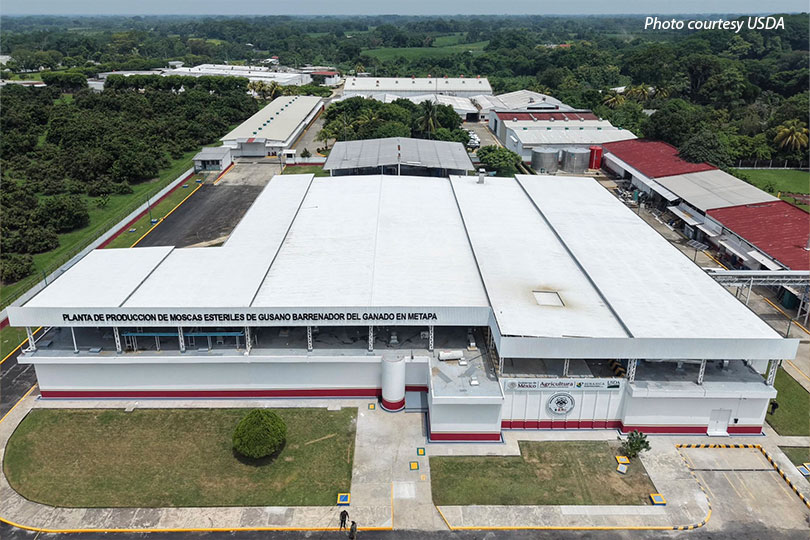
The fight against New World screwworm gained another tool this month as the U.S. Department of Agriculture (USDA) celebrated a grand opening of a sterile fly production facility in Metapa, Mexico.
The 22,000-square-foot facility is expected to eventually produce up to 100 million sterile New World screwworm flies each week.
USDA invested $21 million to renovate and convert the former fruit fly production facility.
U.S. Secretary of Agriculture Brooke Rollins said construction began about 11 months ago and credited the partnership between the United States and Mexico for bringing the project online.
Although the facility is not yet operating at full capacity, production is expected to ramp up quickly.
“Within 8 weeks, we should have 30 million flies, in 12 weeks, 50 million flies, and by this fall, an additional 100 million flies to deploy,” Rollins posted on X.
Sterile flies are the primary tool used to stop the spread of New World screwworm. The sterile male flies mate with the wild female NWS flies, which only mate once in their roughly 21-day lifespan. The resulting eggs do not hatch, helping reduce the overall NWS population.
“The more sterile flies we produce and deploy, the faster we can suppress and ultimately eradicate this devastating pest,” Rollins posted on X.
The additional production comes as federal and state officials continue responding to New World screwworm detections in Texas.
Sterile flies are being released in affected areas while livestock producers, veterinarians and animal health officials work to detect and contain new cases.
“The sterile insect technique has proven successful in eradicating New World screwworm before, but it requires an adequate supply of sterile flies,” said Tracy Tomascik, Texas Farm Bureau associate director of Commodity and Regulatory Activities. “The Metapa facility is an important investment because it expands production capacity and gives animal health officials another valuable tool to suppress the pest. The sooner we can increase the number of sterile flies released, the sooner we can reduce populations and protect Texas livestock.”
Expanding sterile fly production is critical.
USDA estimates a widespread New World screwworm outbreak could cost Texas livestock producers about $732 million annually and result in total economic losses approaching $1.8 billion each year if the outbreak is not contained.
For the latest on New World screwworm cases and USDA information, visit screwworm.gov.
Leave A Comment