
By Keona Ellis
Communications Intern
Combines harvested the last of the Weithorn family’s oat fields earlier this summer, wrapping up another season for a crop that’s become less common on Texas farms.
The McLennan County farm family grows oats, corn, wheat, sorghum and occasionally cotton. They also raise about 100 head of cattle.
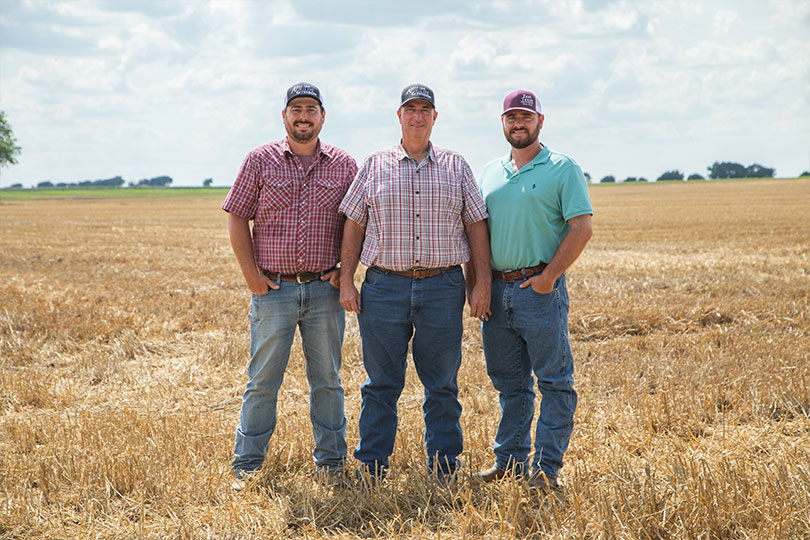
Jason Weithorn farms alongside his father, Mark, continuing the family’s fourth-generation operation.
“Oats is an overlooked crop nowadays, but traditionally it has been grown in Texas for a very long time,” Jason said.
Although fewer Texas farms grow oats today, the crop continues to serve an important role. As a rotational crop, oats help reduce fall and winter soil erosion and provide valuable feed and forage for livestock.
Farmers often saved part of the harvest for seed the following year and fed the rest to their cattle.
Growing oats, however, comes with challenges.
“You got to have patience with oats. It’s not an easy crop to grow,” said Mark Weithorn, a third-generation farmer. “Some years when it falls flat and hail and wind wipe you out, it’s difficult to harvest. And it’s becoming more difficult the last few years than it used to be.”
Heavy rain, hail and strong winds can cause oats to lodge, or fall over, making harvest more difficult and reducing yields. The Weithorn family also face challenges beyond the field. Urban sprawl, low commodity prices and rising input costs put additional pressure on the family farm.
Even with those challenges, the Weithorns remain committed to the future of the farm and the generations that will follow.
“My dad said a long time ago that it’s easier to work because we have somebody coming behind you, and I feel that same way,” Mark said. “I have a generation behind me, so it keeps your interest, your spark and your desire to do it, because you want to continue that legacy.”
Mark said agriculture’s impact reaches far beyond the farm gate.
“Agriculture is a big industry. It’s not just our farm and our individual family,” he said. “It’s the suppliers, equipment dealers, the trucking company and the grocery store. It has a larger impact worldwide, and we tend to forget that.”
Leave A Comment