
By Keona Ellis
Communications Intern
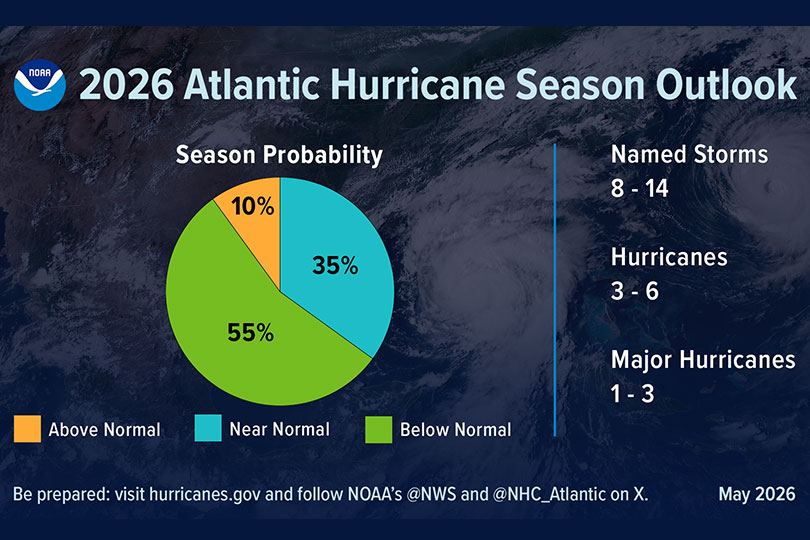
The National Oceanic and Atmospheric Administration (NOAA) is forecasting a below-normal hurricane season for this year.
The hurricane season runs from June 1 through Nov. 30.
NOAA predicts eight to 14 named storms, three to six hurricanes and one to three major hurricanes.
“What’s really going to be driving this is going to be the expectation that a pretty strong El Niño pattern is going to be taking shape towards the end of the season,” said Tom Bradshaw, meteorologist in charge at the National Weather Service in Fort Worth.
Sea surface temperatures across portions of the Central Atlantic and Caribbean Sea remain warm, which could support tropical development. But El Niño typically increases wind shear across the Atlantic Basin, making it more difficult for storms to organize and strengthen.
Bradshaw said El Niño is expected to have a weaker influence early in the season, and more opportunities for storm development are predicted for June and July. The impacts from El Niño are expected to become more pronounced during the peak months of September, October and November period, he said.
Despite the outlook, forecasters stress that residents should not let their guard down.
“Although El Niño’s impact in the Atlantic Basin can often suppress hurricane development, there is still uncertainty in how each season will unfold,” NOAA’s National Weather Service Director Ken Graham said. “That is why it’s essential to review your hurricane preparedness plan now. It only takes one storm to make for a very bad season.”
The seasonal outlook reflects large-scale climate patterns and does not predict where storms may form or make landfall. Those details depend on shorter-term weather conditions that cannot be forecast months in advance. For Texas, tropical systems can be both beneficial and destructive. Bradshaw noted landfalling storms often provide much-needed rainfall, but excessive precipitation can quickly lead to flooding and other impacts.
Advances in forecasting technology are helping improve forecast accuracy.
“NOAA’s rapid integration of advanced technology, including AI-based weather models, drones and next-generation satellite data will deliver actionable science to safeguard the lives and livelihoods of the American people,” NOAA Administrator Dr. Neil Jacobs said.
Additional hurricane preparedness information is available at weather.gov/safety and ready.gov.
Leave A Comment