
By Jessica Domel
Multimedia Reporter
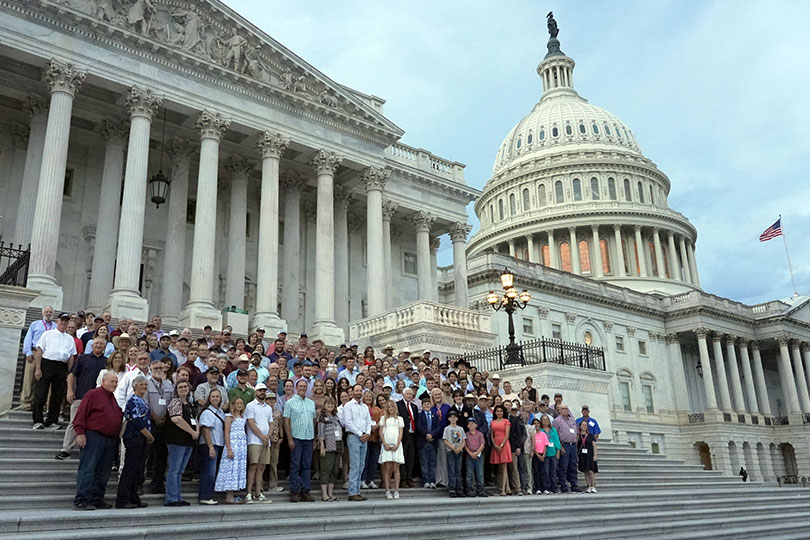
Nearly 300 Texas farmers and ranchers traveled to Washington, D.C., in mid-May to advocate for a farm bill, agricultural labor reform and other issues impacting agriculture.
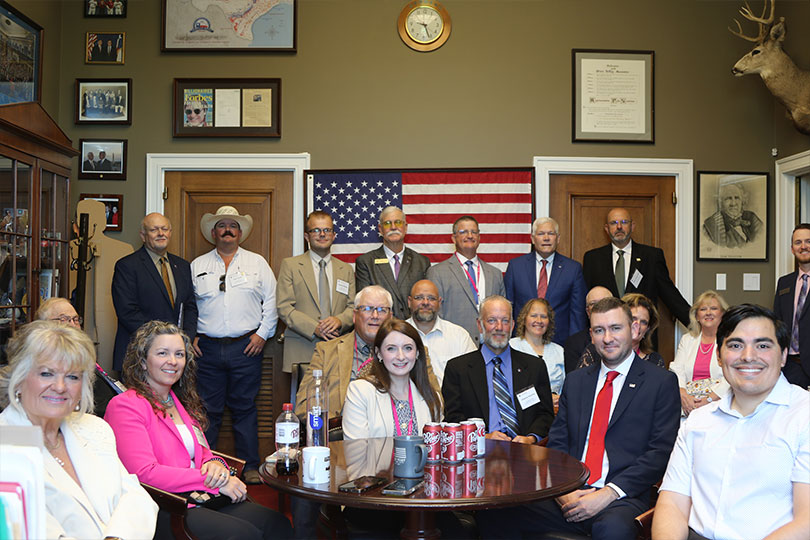
The visit was part of Texas Farm Bureau’s (TFB) annual National Affairs Awards Trip, which gives members the opportunity to meet directly with lawmakers, congressional staff and members of the Trump administration.
Among the top concerns were the farm bill, farm economy, trade, agricultural labor, water, disaster assistance and New World screwworm (NWS).
“They talked about the need to get the farm bill finished,” Laramie Adams, TFB associate director of Government Affairs, said. “What was done in the Working Families Tax Cuts was very good for increasing the farm safety net and getting some of that done, but the job remains. Texas farmers and ranchers are still waiting at a time when input costs are extremely high and commodity prices are fluctuating, and in most cases, very low.”
Farmers and ranchers are operating under the third extension of the 2018 Farm Bill and urging Congress to pass a full, five-year bill.
“We owe it to our farmers and ranchers to get a farm bill done,” Adams said. “Our almost 300 members who were in Washington shared that message with their Congressional members, their staff and cabinet officials.”
The U.S. House of Representatives passed the House Committee on Agriculture’s version of the farm bill in a 224-200 vote April 30.
The Senate Committee on Agriculture, Nutrition and Forestry is expected to release a framework of its version of a farm bill sometime in June.
“We’re working hard to do our part on the farm bill,” U.S. Sen. John Boozman (R-AR), chair of the Senate Ag Committee, told the group. “GT Thompson did a tremendous job in the House.”
In addition to the farm bill, TFB members discussed the current farm economy and the need for timely disaster and economic assistance.
“We talked about input costs, and we’re hearing that there could be a supplemental coming together on weather disaster assistance and then also economic assistance,” Adams said. “We cannot stress enough how important it is to get assistance delivered before the end of the year. Honestly, it’s already too late, but our farmers and ranchers are patient people or they wouldn’t be in the business they’re in, but we owe it to them.”
Boozman said he is working with U.S. Sen. John Hoeven (R-ND), who chairs the U.S. Senate Committee on Appropriations’ subcommittee on agriculture, on another bridge assistance payment for farmers to get them by until the updated Agricultural Risk Coverage (ARC) and Price Loss Coverage (PLC) reference prices take effect later this year.
“We forget that in reconciliation, the Big Beautiful Bill, we passed probably 85% of the farm bill to the tune of about $68 billion increase in farm spending— the most ever by far. In the last Congress, if we thought we could get $10 or $20 billion of additional funding, we’d hit a home run. We were able to get $68 billion. Now, you’re not going to see that until later, but you will see it,” Boozman said. “We’d like to get this bridge payment done. We are also working really hard to finish up that 15% of the farm bill that’s left.”
TFB members also discussed the importance of prioritizing strong, enforceable trade agreements, addressing unfair trade practices and unfair non-tariff barriers, as well as expanding export opportunities for U.S. agricultural products.
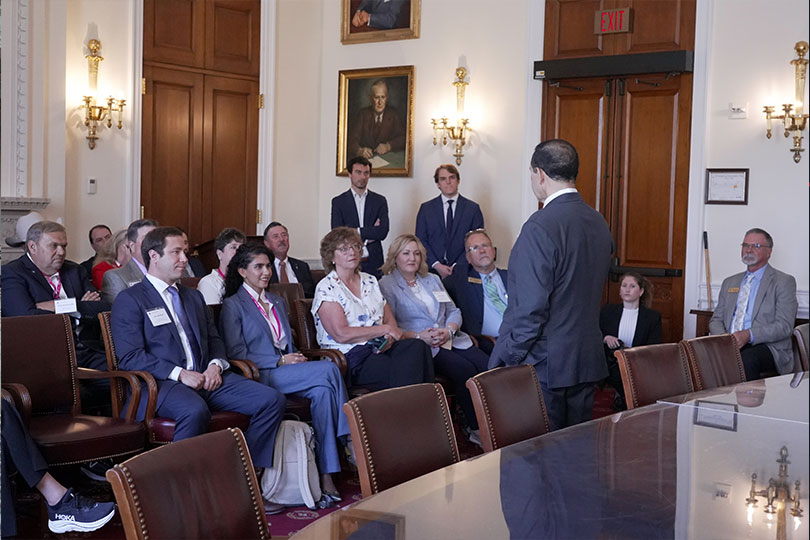
The need for an updated agricultural labor program was also a priority.
“Ag labor is a continuous issue that has not been resolved. More and more of our Texans are using H-2A workers or the program simply because they can’t get workers through any other route, but nothing changes the fact that the program is flawed,” Adams said. “It’s filled with red tape and bureaucracy, and we have to make sure that red tape is cut.”
The threat of New World screwworm entering Texas from Mexico was a key issue, as well.
“New World screwworm is something that we have to be talking about constantly because people need to know how serious of a threat it is to our state, our nation, our beef herd, livestock herd and also our wildlife community,” Adams said. “A lot of it for us at this stage is education, letting folks know that yes, we need to be alert but not alarmed on this and let the consumers know that their food is safe no matter what.”
TFB members emphasized the need for continued funding for surveillance, prevention and rapid response programs, along with maintaining strong animal health provisions in the farm bill to protect U.S. livestock.
U.S. Secretary of Agriculture Brooke Rollins, who grew up in Glen Rose and is the first Texan to lead the U.S. Department of Agriculture, discussed NWS preparedness with the group.
“We broke ground on a facility in South Texas so that we can once and for all never have to worry about this again,” Rollins said. “That’s on top of significant investments, and we’ve already upped our fly production.”
USDA has moved the “polygon,” or the area where sterile flies are dropped, in Texas to prevent the spread of NWS to protect more of the Lone Star State.
The sterile male flies mate with wild female flies, which can only mate once, and they produce unfertilized offspring. That helps reduce, and eventually eliminate, NWS flies in an area.
“We’re doing everything we can to keep it on that side of the border until the big facility can produce 300-400 million flies a week, which will probably be 8-10 months,” Rollins said. “We’re getting closer and making progress.”
She also gave TFB members an update on the Trump administration’s work on behalf of U.S. farmers and ranchers and discussed issues, like high input costs, currently taking a toll on the farm economy.
“There’s no doubt our farmers are struggling,” Rollins said. “The cost of inputs, of course, skyrocketed. There were no new trade deals (under the last administration), but this is years of policy making that we’re working to unwind right now to really open up the market and have real profitability and sustainability for you, your kids and the farmers you represent.”
Mexico’s water debt to Texas under the 1944 Water Treaty was also discussed.
Under the treaty, Mexico is obligated to deliver water from several Rio Grande tributaries back to the Rio Grande for use by Texas. That water is vital to farmers in the Rio Grande Valley who rely on it for irrigation.
The problem is Mexico has fallen short of its delivery debt for the past several years.
“I know it is not a perfect situation. I know many of you in this room are certainly feeling that and have felt it. For our South Texas farmers, I hear the stories all the time, ‘I can only plant 40%, or I can only plant 30% because I just have no water certainty.’ I realize it’s not perfect. I realize there’s a long way to go, but I do want to say for the first time Mexico met our 250,000 acre feet about a month ago,” Rollins said. “We’re on track to continue. They are sending more water than they ever have before.”
Rollins said she believes that is a result of the administration’s direct engagement with Mexican President Claudia Sheinbaum.
The most important message Rollins said she could convey is that the work must continue to protect farm and food security, which is national security.
“The righteous battle continues here in Washington from our president on down that if we’re not able to preserve this way of life, if we keep losing our family farms to foreign adversaries, foreign countries, consolidation, etc., we will lose America,” Rollins said.
TFB leaders say the annual visits help strengthen relationships with lawmakers and keep agricultural priorities at the forefront long after the trip ends.
“I just couldn’t be more grateful for all of the members of the Texas Farm Bureau,” Rollins told TFB Radio following the breakfast. “As the former first runner up in Miss Texas Farm Bureau myself and a scholarship winner, actually, just so grateful to y’all for so much.”
U.S. Deputy Secretary of Agriculture Stephen Vaden also addressed the group as did U.S. House Committee on Agriculture Chairman Glenn “GT” Thompson, Senate Majority Leader John Thune, House Majority Leader Steve Scalise, House Majority Whip Tom Emmer, U.S. Sen. Ted Cruz (R-TX), U.S. Rep. Kat Cammack (R-FL) and U.S. Rep. Don Davis (D-NC).
Leave A Comment