
By Jessica Domel
Multimedia Reporter
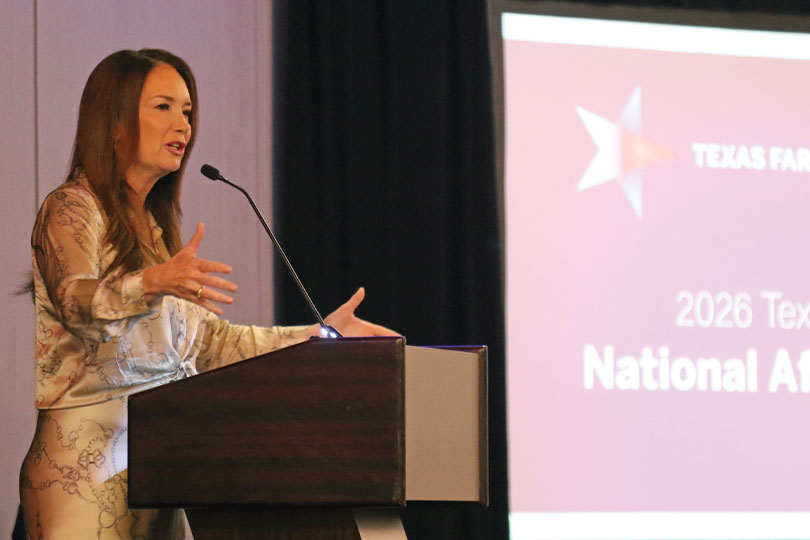
Brooke Rollins, the first-ever Texan to hold the title of U.S. Secretary of Agriculture, welcomed nearly 300 Texas farmers and ranchers to Washington, D.C., this week during Texas Farm Bureau’s (TFB) National Affairs Awards Trip.
The secretary, who grew up in Glen Rose, gave TFB members an update on the Trump administration’s work on behalf of U.S. farmers and ranchers and discussed issues, like high input costs, currently taking a toll on the farm economy.
“There’s no doubt our farmers are struggling,” Rollins said in an exclusive interview with TFB President Russell Boening and the TFB Radio Network. “The cost of inputs, of course, skyrocketed. There were no new trade deals (under the last administration), but this is years of policy making that we’re working to unwind right now to really open up the market and have real profitability and sustainability for you, your kids and the farmers you represent.”
Rollins said the administration has cut the trade deficit by 40%, thanks to trade agreements reached over the past year.
“In the first year alone, we’re at 24 new trade deals with more coming as we speak,” Rollins said.
The secretary also discussed the threat of New World screwworm (NWS) to the livestock and wildlife industries as new cases continue to be reported closer to the U.S.-Mexico border.
“We broke ground on a facility in South Texas so that we can once and for all never have to worry about this again,” Rollins said. “That’s on top of significant investments, and we’ve already upped our fly production.”
USDA has moved the “polygon,” or the area where sterile flies are dropped, in Texas to prevent the spread of NWS to protect more of Texas.
The sterile male flies mate with wild female flies, which can only mate once, and they produce unfertilized offspring. That helps reduce, and eventually eliminate, NWS flies in an area.
“We’re doing everything we can to keep it on that side of the border until the big facility can produce 300-400 million flies a week, which will probably be 8-10 months,” Rollins said. “We’re getting closer and making progress.”
Mexico’s water debt to Texas under the 1944 Water Treaty was also discussed.
Under the treaty, Mexico is obligated to deliver water from several Rio Grande tributaries back to the Rio Grande for use by Texas. That water is vital to farmers in the Rio Grande Valley who rely on it for irrigation.
The problem is Mexico has fallen short of its delivery debt for the past several years.
“I know it is not a perfect situation. I know many of you in this room are certainly feeling that and have felt it. For our South Texas farmers, I hear the stories all the time, ‘I can only plant 40% or I can only plant 30% because I just have no water certainty.’ I realize it’s not perfect. I realize there’s a long way to go, but I do want to say for the first time Mexico met our 250,000 acre feet about a month ago,” Rollins said. “We’re on track to continue. They are sending more water than they ever have before.”
Rollins said she believes that is a result of the administration’s direct engagement with Mexican President Claudia Sheinbaum.
Rollins, who has been traveling Texas and other parts of the nation to host roundtable discussions about issues like input costs, said she hears directly from those involved in agriculture about their goals and concerns.
“I work really hard to be out, literally, in the field, and I’ve learned so much from you,” Rollins told Boening, sharing that TFB has played a role in that effort.
The most important message Rollins said she could convey is that the work must continue to protect farm and food security, which is national security.
“The righteous battle continues here in Washington from our president on down that if we’re not able to preserve this way of life, if we keep losing our family farms to foreign adversaries, foreign countries, consolidation, etc., we will lose America,” Rollins said.
Leave A Comment