
By Jessica Domel
Multimedia Reporter
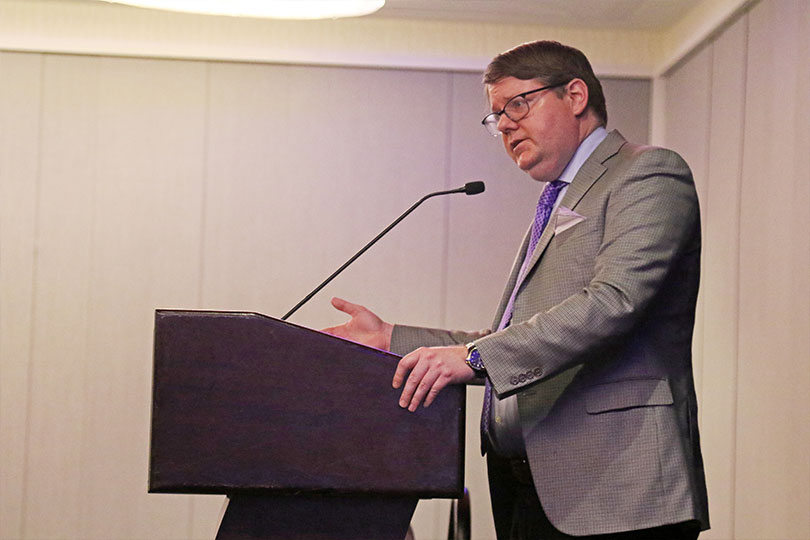
Times are tough in farm country right now, but Deputy Secretary of Agriculture Stephen Vaden says new and pending announcements from the administration and Congress hold promise for U.S. farmers and ranchers.
“Farm debt is climbing as people dip into the savings they have to keep their operation running, but there are things on the horizon which give reason for hope,” Vaden said.
He spoke to a group of nearly 300 Texas Farm Bureau (TFB) members in Washington, D.C. this week during the organization’s annual National Affairs Awards Trip.
He addressed a range of issues impacting agriculture, including rising input costs, labor challenges, New World screwworm (NWS) and farm bill safety net programs.
Input prices
Input costs remain a major concern for agriculture, particularly amid global instability.
“We know when it comes to input costs, there are legitimate questions that need to be asked, whether we’re talking about fertilizer, whether we’re talking about farm equipment, whether we’re talking about seeds or chemicals. All of this was before the conflict in the Middle East,” Vaden said. “This is why we are working closely with our friends at the Federal Trade Commission, as well as the Department of Justice, as they are engaged in active investigations— both criminal and civil—to determine whether or not the markets are functioning properly.”
Vaden, a former judge at the Court of International Trade, has an interest in fertilizer costs because he had a case involving countervailing duties on fertilizer.
“For the record, I found against it twice and sent it back,” Vaden said. “My opinion on that subject has not changed.”
A lack of competition in the fertilizer market has created a problem, Vaden told the group.
“With so many of the inputs that you buy in the fertilizer sector, there’s basically no one competing for your business. We have, for some of these fertilizer inputs, two companies that together combine to control 90% of your market,” he said. “Now, you don’t need a law degree to figure out that if there are only two people in a marketplace, that is not competition. That just, by its natural status, leads to situations where you cannot be sure that the price that you are paying for the commodity is the actual market price because there are not enough people in there mixing it up to fight for your business.”
Vaden said a “load of other companies,” which do not include the current duopoly of fertilizer companies, have expressed interest in providing additional supplies to U.S. agriculture.
“They’re not interested in having countervailing duties put on their products to shield them from competition, and they’re working with this administration to see how quickly they can get their projects, actual meaningful projects of commercially significant size, off the ground,” Vaden said. “I’m confident that as a result of the conversations that we have had with some of these other companies, some of these other investors, as we go through this calendar year, we are going to have announcements that we can make publicly as these projects come online.”
One announcement is expected soon.
“Now, they just have a little purchase they need to make as the final step that their board of directors has approved, and once that purchase is made there will be a big announcement with regard to one of the major fertilizer categories,” Vaden said. “All of this points to the issue in that we should be onshoring this production here in the United States.”
Ag labor
On the ag labor front, Vaden said the U.S. Department of Agriculture (USDA) and Department of Labor have worked together to make the Adverse Effect Wage Rate (AEWR) more economic.
The AEWR is the minimum hourly wage rate that employers who use the H-2A ag guestworker visa program must pay.
“(It) was recently upheld by a federal judge in California,” Vaden said. “We are glad that rule will continue in effect. That one rule will save farmers $2 billion in labor costs over the next few years.”
New World screwworm
Vaden said USDA is also making progress in the fight against New World screwworm, a pest that threatens livestock, wildlife, pets and humans by burrowing into open wounds.
“The best news that I have with regard to the New World screwworm is that, thanks to the scientists at the Agricultural Research Service (ARS), by this fall, we should have a new sterile fly to send out to combat it,” Vaden said.
Currently, USDA distributes male sterile flies in South Texas along the border and in parts of Mexico.
These sterile flies mate with female NWS flies, which only mate once, and produce unfertilized eggs. This helps reduce, and eventually eliminate, the NWS population in an area.
ARS researchers developed a technique that improves the efficiency of sterile fly production.
“It has created a technique by which we only produce sterile male flies, and sterile male flies are what are necessary in order to push the pest back south. Currently, when we produce flies, we get half male and half female,” Vaden said. “Unfortunately, females are not what we need for this exercise. So, we lose half our production.”
Thanks to the ARS technique, which Vaden expects the Environmental Protection Agency to approve by the fall, USDA will double sterile fly production using existing facilities and equipment.
“With that level of fly production, we will be able to meaningfully not only halt further northern progress but begin to push the fly back and away from the United States,” Vaden said.
ARC and PLC payments
Texas farmers can expect to see a farm bill safety net program payment this year.
“It will be the first meaningful payment you have received in about five or six years,” Vaden said.
The One Big Beautiful Bill Act, or HR 1, increased reference prices for farm bill safety net programs—Agriculture Risk Coverage (ARC) and Price Loss Coverage (PLC)—to reflect the cost of production.
“They had withered away over time because the prior administration didn’t care about it,” Vaden said. “Those provisions go into effect the first of October of this year. Plus, for this year, you get an added bonus. You don’t have to elect ARC or PLC. For every eligible farming operation, we’re going to do the calculation for you under ARC and PLC, and whichever one would pay you the most money, that’s what you’re getting on the first of October.”
The larger payments are available this year only.
“Unfortunately, under the terms of the law, it’s just a one year thing, but what isn’t a one year thing are those increased reference prices. That is now in law that will continue,” Vaden told the TFB Radio Network. “ARC and PLC will once again be the meaningful safety net that it was prior to about five or so years ago.”
Capitol Hill visits
He said when farmers and ranchers visit with lawmakers and members of the administration, it makes a difference and helps them craft farm policy moving forward.
“It’s one thing for me to be able to sit in a meeting and say, ‘This is what I think.‘ It’s another thing for me to be able to sit in a meeting and say ‘Not only is this what I think, but this is what farmers all across the country think, including in important states like Texas.’” Vaden said. “It’s the validation that this is an issue and this is a problem that needs to be solved and here’s how we need to solve it that makes a real difference.”
TFB members will also hear from U.S. Secretary of Agriculture Brooke Rollins and members of the Texas Congressional delegation Tuesday.
Leave A Comment