
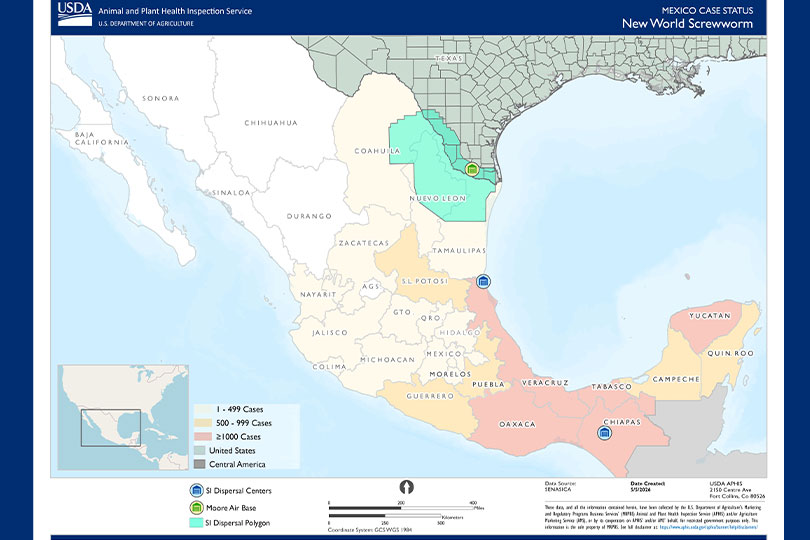
The U.S. Department of Agriculture (USDA) is expanding the New World screwworm (NWS) sterile fly dispersal barrier further into Texas as federal and state officials work to prevent the pest’s continued movement north.
The updated sterile fly dispersal area, also referred to as a polygon, is a precautionary effort to expand the biological border across more of South Texas along the international border with Mexico.
New World screwworm is the larval stage of a fly that feeds on the living tissue of warm-blooded animals. Infestations can be deadly if left untreated and pose serious threats to livestock, wildlife, pets and, in rare cases, humans.
The pest was eradicated from the U.S. in the 1960s using the sterile insect technique, which involves releasing sterilized male flies to disrupt reproduction and collapse wild populations.
Recent detections in Mexico prompted increased surveillance and response efforts from USDA and state animal health officials.
Texas Farm Bureau (TFB) has continued working with state and federal officials on response and preparedness efforts.
“Keeping New World screwworm out of the United States requires a coordinated and proactive approach,” Tracy Tomascik, TFB associate director of Commodity and Regulatory Activities, said. “The expansion of the dispersal area is another important step in slowing the movement of the pest and protecting livestock producers, wildlife and animal health.”
Tomascik noted the sterile fly program has a long history of success and remains one of the most effective tools available to combat screwworm.
“The earlier we can suppress populations and contain the spread, the better positioned we are to protect U.S. livestock and wildlife,” he said.
USDA recently broke ground on the new domestic sterile fly production facility at Moore Air Base in Edinburg. The facility is expected to initially produce up to 100 million sterile flies per week and eventually scale up to 300 million flies weekly.
Additional dispersal operations are also underway in Mexico, including a facility in Tampico that supports aerial releases across affected regions.
The potential economic impact of a screwworm reintroduction is significant.
USDA estimates a NWS outbreak in Texas alone could cost producers $732 million per year and result in a total economic loss of $1.8 billion for the state.
Preparedness efforts also continue at the state level. Gov. Greg Abbott issued a disaster declaration related to the threat of New World screwworm earlier this year, and Texas agencies continue coordinating response plans with livestock groups and federal officials.
For more information and the current situation map, visit screwworm.gov.
Leave A Comment