
By Shelby Shank
Field Editor
Students across Texas recently learned about peaches during Texas Farm Bureau’s (TFB) Farm From School program in April.
Each month, kindergarten through fifth-grade students virtually “meet” with a farmer or rancher through Farm From School on a video conferencing app.
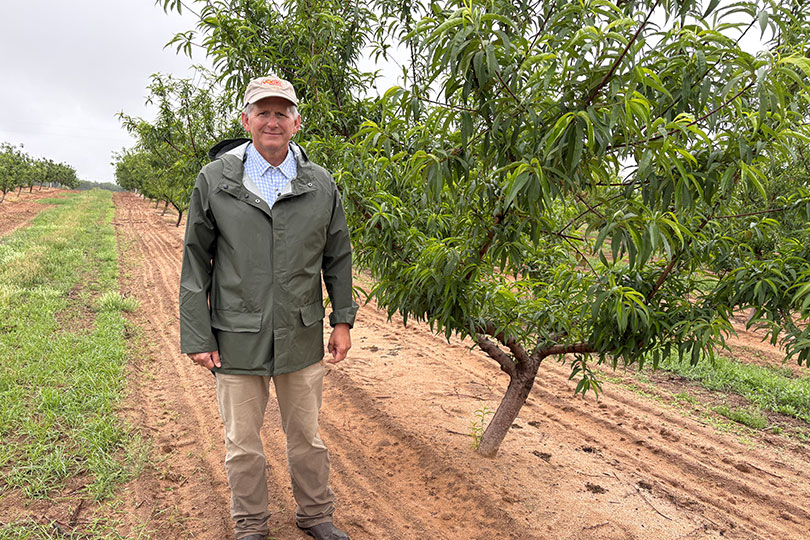
This session, students learned from Jamey Vogel, a peach grower in Fredericksburg, who gave a tour of his family’s farm and taught students how peaches are grown and harvested.
During the virtual field trip, students saw young peach trees that were planted in February 2022.
“This is a new orchard, and these trees are fairly small now but will be full-sized in several years and produce more fruit,” Vogel said.
Peach trees require careful planning and are a long-term investment. Vogel explained that trees can begin producing fruit as early as their second year, but it takes time to reach full production.
“It’ll be a small crop because the tree is small, but as they get larger, they can produce as much as three or four bushels per tree, which is 150 to 200 pounds of peaches on a mature tree,” Vogel said.
Vogel’s orchard spans about 90 acres with nearly 8,000 trees that produce between 400,000 to 500,000 pounds of peaches each year.
Unlike some crops, peaches aren’t grown from a single seed. Instead, growers rely on nurseries to propagate specific varieties using a process called budding.
“We get the trees from nurseries in Tennessee, California and Texas,” Vogel said. “They’ll cut budwood and use that to duplicate the varieties of peaches that we have.”
Budwood refers to small cuttings taken from a desired peach variety. Those cuttings are grafted onto rootstock by nursery specialists. This allows growers to replicate trees that produce consistent fruit in size and flavor.
They grow about 22 peach varieties at Vogel Orchard. Harvest stretches from early May through mid-August.
However, harvest is no simple task.
“Everything is picked by hand,” Vogel said. “Peaches don’t ripen all at the same time like apples do, so we have to go through the orchard every other day and pick the ones that are ready.”
Each variety may be harvested multiple times over a 10 day to two-week period.
Farmers know when the fruit is ready to be harvested based off the peach’s color.
“We look at their color and pick the peaches when they’re firm, so they soften up in a few days for customers,” Vogel said.
While color is the main indicator, peaches can also vary in appearance depending on the variety. Most are red, yellow or orange on the outside, while the inside is typically yellow.
In addition to selling fresh peaches, Vogel makes products like peach butter and preserves. He also grows plums, blackberries and raspberries that are sold at the family’s fruit stand.
More information
This spring, K-5 classes explored onion production, peanut shelling and will learn about wheat milling in May.
Students in grades 6-12 learned about bull production in February, and the remaining session will focus on forestry.
Sign up for the fall 2026 program will open in June.
Visit texasfarmbureau.org/aitc for more information and the latest announcements on TFB’s Ag in the Classroom activities.
Leave A Comment