
By Shelby Shank
Field Editor
Feral hogs continue to leave a growing trail of destruction across fields and pastures.
Justin Allen, a rancher in Rosebud, has seen the damage become more widespread in recent years.
“It’s substantial in some places, and it seems like we’re getting more damage across the area daily,” Allen said. “It’s from row crops to pastures, and I’ve even seen damage in some residential areas.”
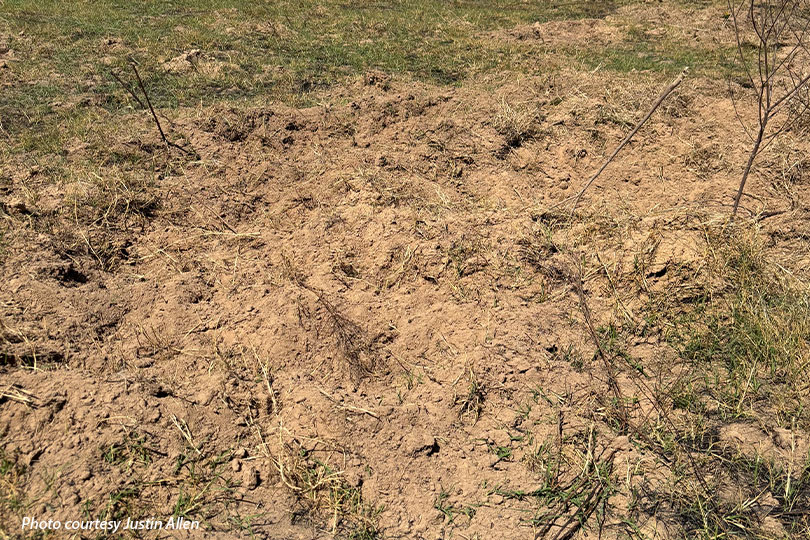
The impact on pastures is especially severe. Hogs root through fields and grazing land in search of food, destroying forage and leaving fields difficult to manage.
“They’re rooting up our pastures, which is destroying our Coastal bermudagrass,” he said. “When we lose those coastal stands, the ground becomes inoperable unless we start over, plowing it down and smoothing it out. Even when we do that, the hogs come right back and reroot everything.”
Row crop farmers are also feeling the strain. As crops like corn begin to emerge, hogs root up young plants and can destroy a field overnight, forcing farmers to replant.
“We’re seeing them root up stands as corn is coming out of the ground,” Allen said. “When that happens, we have to replant, and those losses add up to an astronomical amount of damage over the year.”
Farmers, ranchers and landowners use a variety of control methods, including trapping, baiting and even aerial control measures.
“When we see hogs, we’re trying to eliminate them,” Allen said. “We’re using every measure possible to eradicate them, but it still feels like a losing battle.”
Part of the challenge lies in the hogs’ rapid reproduction rate. Sows are capable of producing multiple litters each year, allowing populations to quickly spiral out of control.
“It’s a number game,” Allen said. “When a female can have a litter at six months old and produce two to three litters a year, they multiply really fast.”
In addition to direct damage to fields and pastures, feral hogs pose a broader threat to animal health. The animals can serve as hosts for pests and diseases, including the potential spread of New World screwworm.
“With the feral hog population, the screwworm could be a very dramatic hit to the industry,” Allen said.
Controlling the feral hog population has been a priority issue for Texas Farm Bureau for several years.
The state’s largest general farm and ranch organization previously led efforts to expand the control methods available to farmers and ranchers to include Kaput Feral Hog Bait.
“Feral hogs are a significant economic and environmental challenge for agriculture,” Tracy Tomascik, TFB associate director of Commodity and Regulatory Activities, said. “Farmers, ranchers and landowners are investing time and resources into control efforts, but without coordinated management, it’s difficult to stay ahead of their expanding populations.”
Leave A Comment