
By Julie Tomascik
Editor
The U.S. Department of Agriculture (USDA) awarded a $610 million construction contract for a sterile fly production facility in the Rio Grande Valley as part of a broader effort to strengthen defenses against the New World screwworm.
The facility will be built at Moore Air Base in Edinburg under a contract issued by the U.S. Army Corps of Engineers to M. A. Mortenson Co., a construction and development firm based in Minnesota.
“The Army Corps of Engineers is an essential partner in bringing this facility to life and further highlights the Trump administration’s government wide effort to fight the New World screwworm threat in Mexico,” U.S. Secretary of Agriculture Brooke Rollins said. “The Army Corps is the best in the business and their engineering expertise and proven track record in delivering complex projects will help ensure we can build a modern, resilient facility that protects American agriculture from invasive pests for decades to come. This first of its kind facility on U.S. soil will ensure we are not reliant on other countries for sterile flies.”
The project will create a specialized biosecure facility designed to mass-produce sterile New World screwworm flies used to suppress populations of the destructive livestock pest.
The sterile flies will be released into targeted areas. Because female screwworm flies mate only once, mating with sterile males results in eggs that do not hatch, helping reduce wild populations. The method, known as the Sterile Insect Technique, has been used for decades to control and eradicate screwworm outbreaks.
Construction of the facility is part of USDA’s broader strategy to address the renewed threat of screwworm spreading north through Mexico. The parasite poses a serious risk to livestock, wildlife and other animals if it reaches the United States.
The U.S. Army Corps of Engineers will oversee the design and construction of the facility.
Currently, USDA works with an international facility in Panama that produces about 100 million sterile flies each week for release in areas where screwworm has been detected. The new Texas facility will strengthen domestic preparedness and reduce reliance on foreign production capacity.
Agricultural organizations say the investment is an important step toward protecting the nation’s livestock and wildlife.
“New World screwworm would have devastating consequences for livestock producers if it were to reach the United States,” said Tracy Tomascik, Texas Farm Bureau associate director of Commodity and Regulatory Activities. “Building a domestic sterile fly facility strengthens our preparedness and provides another layer of protection for farmers, ranchers and the animals they care for.”
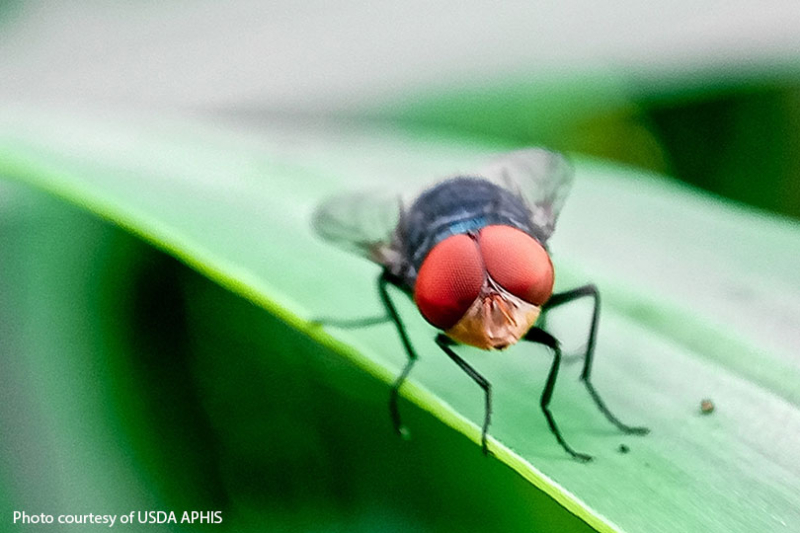
The New World screwworm is a parasitic fly that lays eggs in open wounds of warm-blooded animals. The pest gets its name from how the larvae burrow, or “screw,” into wounds as they feed on living tissue. If left untreated, infestations can be fatal.
The metallic green-blue fly, about twice the size of a common house fly, has distinctive orange eyes.
If the screwworm were to reenter the United States, it is estimated it could cause $2.1 billion in losses to the Texas cattle industry and $9 billion to the state’s hunting and wildlife sector.
For more information about New World screwworm, visit screwworm.gov.
Leave A Comment