
By Jessica Domel
Multimedia Reporter
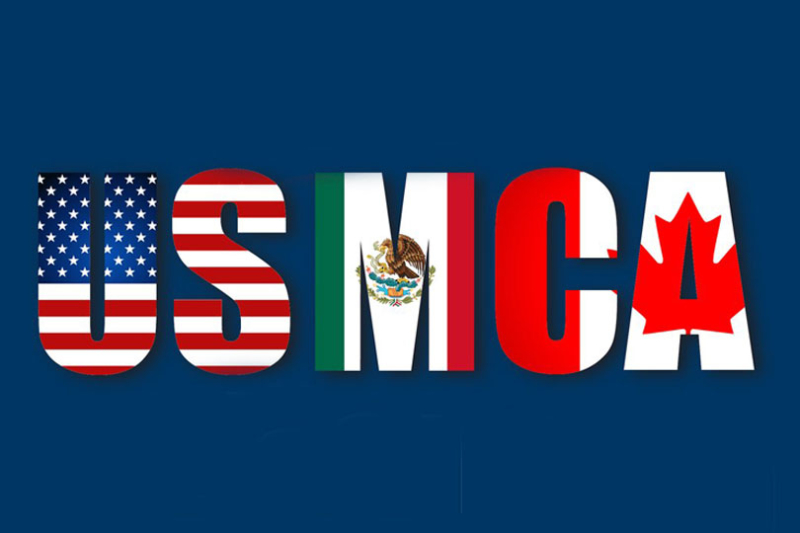
The U.S.-Mexico-Canada Agreement (USMCA) supported $6.4 billion in Texas agricultural exports and 28,700 jobs last year, and if the administration fails to renew it, Texas farmers, ranchers and businesses could pay the price.
This year, the administration is expected to review, and potentially renew, the trade deal.
“It’s critical for our national economy, not just the Texas economy,” Chris O’Connor, general manager of Willamar Cotton and Grain, told the Texas Farm Bureau Radio Network at a recent Farmers for Free Trade roundtable event. “Renewing it would keep our customers with a place to go with their grain. Not renewing it? I don’t know where it would go. I don’t know what we’d do. We’d restructure, and we’d survive somehow, but it would make my life very difficult and expensive.”
Willamar Cotton and Grain is a commercial elevator owned by farmers.
“We bring in the farmers’ grain. We also export. We’re an export house. So, we’re exporting direct to Mexico customers, and we’re also a gin,” O’Connor said.
USMCA secured duty-free access to the Mexican and Canadian markets for U.S. agricultural goods, increasing exports and strengthening trade stability.
That stability is important to farmers like Charles Ring, who grows corn, sorghum and cotton in San Patricio County.
“When things are up in the air, it’s really hard to make plans,” Ring, a San Patricio County Farm Bureau member, said. “It’s really hard to budget when you don’t know where your market is at. We need things to be stable.”
Knowing there are markets for U.S. grown goods is also beneficial when farmers are working to secure financing for the next year’s crop.
“It certainly helps me go to the banker when he knows,” Ring, who also serves on the board for the Texas Corn Producers Association, said. “If I produce corn, and I can’t sell it, he’s out the window with me.”
If the administration were to withdraw from USMCA, the demand for those products could be impacted.
“It would slow,” O’Connor said. “There would be a very painful adjustment period, and then I believe it would come back somewhat, but you don’t want Brazil to come in and take our market. Once you lose a market, sometimes you don’t get it back. That’s the scary part.”
There’s also a chance tariffs could increase or the cost of the products U.S. businesses are buying from Canada and Mexico could rise.
“If the Mexican government came in and put a tariff on our corn going into Mexico, that could certainly affect us,” Ring said. “We wouldn’t be able to sell at the levels we are, and plus we’d have to find another home for a lot of (our crop). There’d be a loss of price and value when we can’t move it into the market.”
The review and potential renewal of USMCA does bring an opportunity for improvement to the trade deal.
O’Connor said he’s hoping a provision is added to ensure Mexico delivers water to the Rio Grande Valley on a timely basis as outlined in the 1944 Water Treaty.
“If it’s well planned, well thought out, I think it’s a good idea,” O’Connor said. “We need it. We have no irrigation or very little irrigation.”
The water deliveries outlined in the treaty are vital for farmers in the Rio Grande Valley.
Without the guarantee of the availability of the irrigation water, farmers stopped growing sugarcane, which led to the closure of the state’s only remaining sugar mill two years ago.
O’Connor said the water delivery points also need to be addressed to ensure farmers are able to use it before it hits the gulf.
USMCA replaced the North American Free Trade Agreement during President Trump’s first term in 2020.
“When NAFTA was signed in 1992, the U.S. exported to Canada and Mexico about $9 billion worth of food product. It was not insignificant and was an important market even back then, but it was $9 billion. In 2024, we exported $60 billion,” Brian Kuehl, executive director of Farmers for Free Trade, said.
In a nod to the USMCA precursor, Farmers for Free Trade kicked-off a USMCA roundtable series at the historic San Antonio site where NAFTA was signed in 1992.
According to the organization, Texas exported $1.99 billion in meat products, $853 million in dairy products, $727 million in oilseeds and grains, $634 million in fruits and tree nuts and $426 million in miscellaneous food products to Mexico and Canada in 2025.
The majority of the sales from Texas, at $5 billion, were to buyers in Mexico.
In 2025, Mexico bought $750 million worth of Texas pork, where it accounted for over 90% of Texas pork exports to the world, according to Farmers for Free Trade.
The group reports Texas exported $426 million in miscellaneous fresh fruit to Canada in 2025.
If USMCA is renewed this year, it will remain in effect for 16 years with another review slated for 2032.
If the U.S. fails to renew USMCA, the trade agreement will expire in 2036.
Leave A Comment