
Emmy Powell
Communications Specialist
Students across Texas recently learned how onions are grown during Texas Farm Bureau’s Farm From School Spring 2026 program.
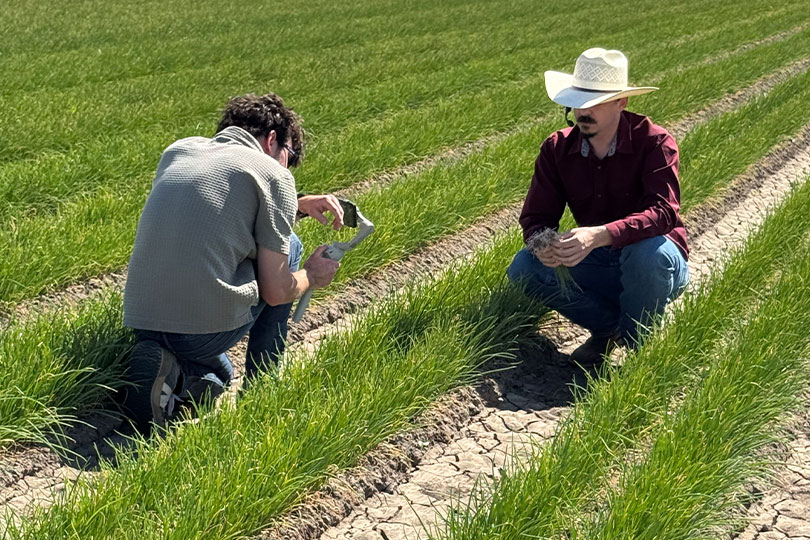
Throughout the February session, kindergarten through fifth grade classrooms connected virtually with the Dixondale Farms Manager Zach Perry, who shared insights into the full onion production process from seed to harvest.
He showed students around the 113-year-old farm in Carrizo Springs, where onions and cantaloupes are grown on 2,100 acres.
Perry discussed how onion production begins with tiny seeds that are planted and nurtured using precise water and nutrient management.
“They like controlled water, which we don’t have much water, but we control it with a channel that slowly runs down the whole row,” he said.
The farm uses an irrigation system to ensure consistent moisture for growing plants and controlled fertilizer placement to help onions develop strong roots and healthy onion tops.
Students learned that each leaf of an onion plant corresponds to a ring inside the onion bulb.
“Each leaf on an onion plant is actually a ring of the onion,” Perry said. “If you cut open an onion, and you count how many rings are inside of it, then you’ll know how many leaves the plant had when it changed into the bulb.”
Farmers typically look for about 13 leaves as a sign the onion is mature and ready for harvest.
The virtual tour highlighted the science behind growing onions.
From planting small transplants to harvesting full-size onions, the lifecycle can take several months and requires careful attention to weather, water and soil needs.
Each onion is planted about four inches apart to allow room for growth and access to nutrients and water.
“It is important to give them enough space and room to where they’re not taking too much water and nutrients from each other and that they’ve got enough space to turn into the bulb and move the ground as they get bigger,” Perry said.
Onions are a labor-intensive crop, requiring harvest by hand. Workers kneel in the rows, pull the onions and bundle them before shipping.
Perry noted that onions are resilient and thrive when environmental conditions are managed effectively.
Students asked Perry why onions make their eyes water.
“Onions release sulfuric acid in the air when you cut them. It makes your eye tear up,” he said. ”That same chemical that makes your eyes water is part of why onions are so healthy. So, it’s kind of a good and bad thing. You’ll have to cry maybe here and there, but it’s good for you.”
The virtual tour kept students engaged with opportunities to ask questions and see real agricultural practices live from the field, reinforcing connections between classroom learning and farming.
More information
This spring, K-5 classes will also explore peanut shelling, peaches and wheat milling in upcoming sessions.
Students in grades 6-12 learned about bull production in February, and the remaining session will focus on forestry in May.
Sign up for the fall 2026 program will open in June.
Visit texasfarmbureau.org/aitc for more information and the latest announcements on TFB’s Ag in the Classroom activities.
Leave A Comment