
By Jessica Domel
Multimedia Reporter
The need for a reliable agricultural workforce and reforms to the H-2A guestworker visa program remain top-of-mind for U.S. farmers, ranchers and lawmakers.
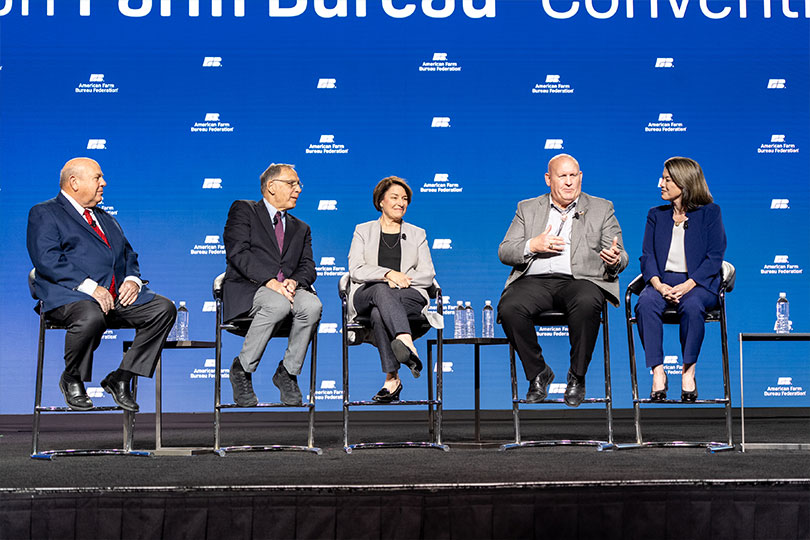
In a panel discussion at the American Farm Bureau Federation’s Annual Convention this week, the chairmen and ranking members of the U.S. House and Senate Agriculture Committees discussed the importance of addressing labor in Congress.
“Recently, there was a farmer that testified about how a decade ago the H-2A program really saved him, and unfortunately, what he said is the H-2A program, as it stands today, is probably going to put him out of business,” Glenn “GT” Thompson (R-PA), chairman of the House Agriculture Committee, said. “It’s just not working.”
In the last Congress, Thompson put together a bipartisan taskforce to examine ag labor issues and H-2A.
The Congressional taskforce published a final report with 21 recommendations to address the issues, 15 of which were unanimous.
“We have taken those to legislative counsel. We’d have probably been a little further ahead if we didn’t have that goofy month-and-a-half shutdown because we lost all access to Department of Labor experts to give us technical assistance,” Thompson said. “Well, they’re back, and we’re just about finished up with that.”
Thompson hopes to release a draft for discussion soon.
“I really think it’s important that the different organizations, such as Farm Bureau, put their eyes on it to make whatever suggestions or recommendations to refine it,” Thompson said. “The biggest thing, why people always told us in the past we couldn’t do something, was because the border wasn’t under control. Now, I would argue that the border’s always been under control. It was just under control by the cartels previously, and today, it’s under control of the United States of America. So, that excuse is gone.”
U.S. Sen. John Boozman (R-AR), chairman of the Senate Agriculture Committee, said when he visits with agricultural groups, labor is often one of the first topics that comes up. He said now that the border is secure, it’s time to address ag labor.
“H-2A is not working with the wage issues and all of that. Perhaps, we can get that done short-term,” Boozman said. “We need massive reform. The good news is, on both sides of the aisle, I think we’re getting that message of you all’s hard work.”
U.S. Senate Ag Committee Ranking Member Amy Klobuchar (D-MN) said Sen. Michael Bennett has a bill that she has co-sponsored that would fix the H-2A program and make sure there are year-round visas.
“We are doing something on wage certainty—protecting the existing workforce,” Klobuchar said.
She noted agriculture is not the only industry that often relies on workers with visas.
“Just think of what we could do if we looked at it and said, ‘Okay, we’ve worked on securing the border, so now let’s just look at some of these areas where we really need help.’ It includes ag, but that’s not the only one—healthcare (and) hospitality,” Klobuchar said.
She said the country needs a smart immigration system that allows for workers and secures the economic needs of farmers and ranchers and encouraged Farm Bureau members to talk to lawmakers about the need for ag labor and immigration reform.
U.S. House Ag Ranking Member Angie Craig (D-MN) said there’s been some good bipartisan work done so far on ag labor, but challenges remain.
“I got a text a couple of days ago from one of my dairy farmers, and ICE (Immigrations and Customs Enforcement) agents were sitting at a gas station near the dairy farm, and people didn’t want to come to work,” Craig said. “Whether they were legal immigrants or not, they don’t want to come to work because they fear in this environment right now.”
U.S. Secretary of Agriculture Brooke Rollins also addressed ag labor at the AFBF convention Monday, saying labor costs have risen 47% since 2020.
“Our Secretary of Labor (Lori) Chavez-DeRemer and I have been working on this issue since the beginning of the administration. The Department of Labor last month issued their interim final rule to change the methodology to establish the adverse effect wage rate for H-2A program, delivering much needed relief to many of you across this great country,” Rollins said.
She noted that change alone will save farmers over $2 billion in labor costs every year.
The secretary said the Department of Homeland Security is also working to make is easier for farmers to apply for H-2A workers.
“We are shortening the time, making it more efficient and hopefully, making it much less expensive to all of you, understanding that there is still much more work to do on labor,” Rollins said. “My commitment to you is we remain hyper-focused on that.”
Leave A Comment